Bulgarian and Romanian municipalities are competing for 63 million euros for tourism and bike routes
The requested funding under the “Interreg Romania–Bulgaria” program exceeds the available funding by nearly 7 million euros
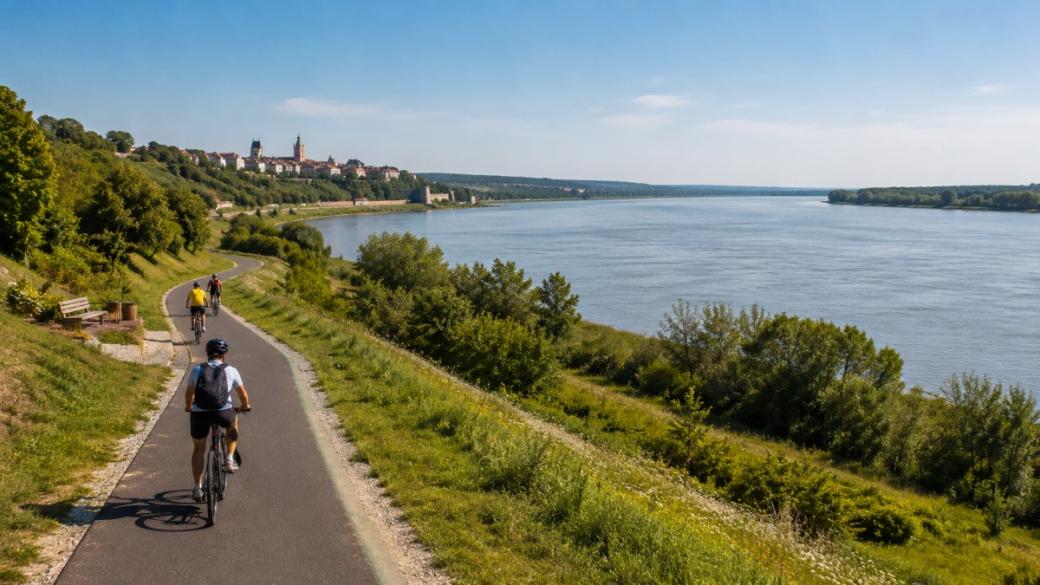
© ECONOMIC.BG / ChatGPT
~ 4 min read
 Gloria Hristova
 Eleven cross-border projects aimed at developing sustainable tourism, green mobility, and cycling infrastructure between Bulgaria and Romania are applying for European funding totaling 63 million euros. All pre-approved concepts have already submitted their full project proposals under the Integrated Territorial Strategy of the “Interreg VI-A Romania – Bulgaria” Program, according to the Regional Information Center in Ruse.
However, the requested funding exceeds the available budget under the call – which is 56.2 million euros – by nearly 7 million euros. This means that passing the first stage does not guarantee funding, and the projects will now be evaluated and ranked.
Ten Bulgarian municipalities are participating in the initiatives: Ruse, Vetovo, General Toshevo, Tutrakan, Glavinitsa, Belene, Gulyantsi, Balchik, Byala, and Oryahovo. Their partners include Romanian municipalities, county administrations, nongovernmental organizations, and institutions on both sides of the border.
The concepts approved in the first stage include investments in bicycle trails, safety measures along the EuroVelo 6 route, the development of natural and cultural attractions, digital tourism services, and support for local businesses.
The full list of the 11 concepts selected for the second stage has been published by the “Interreg VI-A Romania–Bulgaria” Program.
Ruse and Calarasi Plan a Joint Cycling Network
The Municipality of Ruse is participating as the lead partner in the BRAND PRIx project – Bicycle Routes Around Nature Districts – together with the Romanian municipality of Calarasi. The project aims to plan, restore, and promote bicycle routes through natural and tourist sites. The idea is to combine these routes into a single cross-border product that encourages visitors to stay longer and travel without a car.
The Ruse region is also participating in the RIVER & RIDE DANUBE project, led by the Regional Inspectorate for Environment and Water – Ruse, in partnership with the Romanian municipalities of Mănăstirea and Dorobanțu. This project also combines tourism along the Danube with sustainable forms of transportation.
The municipality of Vetovo is participating in the VIA ISTRUM project alongside the Romanian municipalities of Gârcov and Bujor and the National Center for Information Services. The initiative is part of a broader goal to connect smaller towns and tourist sites that are often left off the main routes.
EuroVelo 6 as the Backbone of New Investments
A large portion of the projects are directly or indirectly linked to EuroVelo 6 – one of the main European cycling routes, which follows the Loire, Rhine, and Danube rivers and connects the Atlantic Ocean with the Black Sea.
The cross-border region between Bulgaria and Romania has significant tourism potential along the entire length of the Danube, but it remains fragmented by missing or poorly connected cycling sections, insufficient signage, and limited services for visitors. It is precisely these issues that the proposals from Tutrakan, Glavinitsa, Belene, Gulyantsi, and Oryahovo aim to address.
The Municipality of Tutrakan is the lead partner in the RiDE – Ride and Experience the Danube project. Other participants include the Municipality of Glavinitsa, the Romanian Municipality of Oltenita, and organizations from the tourism and non-governmental sectors.
The VELODANUBE project aims to develop a cycling route from Belene to the Romanian city of Calafat. The lead partner is the Municipality of Belene, and participants include the Municipality of Calafat and associations from both countries.
Belene is also involved in a second proposal – ECOCONNECT – which combines sustainable tourism, green mobility, and cultural heritage in partnership with five Romanian municipalities.
The Municipality of Gulyantsi leads the DARTI project – Danube Taste and Roads: History, Tourism, and Innovation. It emphasizes local history, tourist routes, traditional cuisine, and the use of digital solutions to showcase them.
Oryahovo is a partner in ENCOTOUR, which aims to improve the attractiveness and connectivity of the area along EuroVelo 6 between the Romanian municipality of Cârna and the Bulgarian city.
Bicycle Routes from the Danube to the Black Sea
Some of the concepts extend the scope of investments beyond the Danube-region municipalities and seek a connection to the Black Sea coast.
The municipality of General Toshevo participates in RIDEBLUE-GREENBIKE, led by the Calarasi County Council. The project aims to develop cross-border cycling tourism and biodiversity conservation from the Danube to the Black Sea. The “Salt Water: General Toshevo Branch” association is also a Bulgarian partner.
Balchik and the Romanian city of Navodari are applying with BLACK SEA CYCLING – a project that views cycling tourism as a tool for sustainable economic growth in the Black Sea region.
The Municipality of Byala is the lead partner in EVREST – an initiative for cross-border cycling adventures and sustainable tourism, developed jointly with the Romanian Municipality of Oltenita.
Thus, the projects form a potential network that starts from the municipalities along the Danube, passes through Dobruja, and reaches the Bulgarian and Romanian Black Sea coasts.
From Infrastructure to Local Business
Under this call for proposals, funding is available not only for new bike lanes but also for improving existing infrastructure, making routes safer, enhancing natural and cultural sites, and creating digital services.
Eligible activities include information systems, tourism apps, signage, rest areas, and services that connect local producers, hotels, restaurants, museums, and cultural institutions to the overall tourism route.
Projects can receive between 300,000 and 6 million euros in grant funding. Beneficiaries are required to provide 2% co-financing.
Approved projects should help shape a common cross-border tourism region in which the Danube, EuroVelo 6, and the Black Sea coast are connected through cycling infrastructure, natural and cultural heritage, and shared visitor services.
Translated with DeepL.
Co-Funded by the European Union. Views and opinions expressed are however those of the author(s) only and do not necessarily reflect those of the European Union. The European Union cannot be held responsible for them.