How will Bulgaria and the region ensure a more secure and affordable energy supply?
A new energy strategy, the development of gas infrastructure and regional cooperation were among the key topics at the Global Innovation Summit 2026
~ 6 min read
 Gloria Hristova
Secure energy supplies are no longer sufficient to guarantee the sustainability of economies. Affordable prices, a diversity of sources and supply routes as well as long-term planning of energy infrastructure are becoming increasingly important. These topics were the focus of an international discussion during the Global Innovation Summit 2026 in Sofia, where representatives from the energy sector, government institutions and academia discussed how countries can strengthen their energy security amid geopolitical instability and rising consumption.
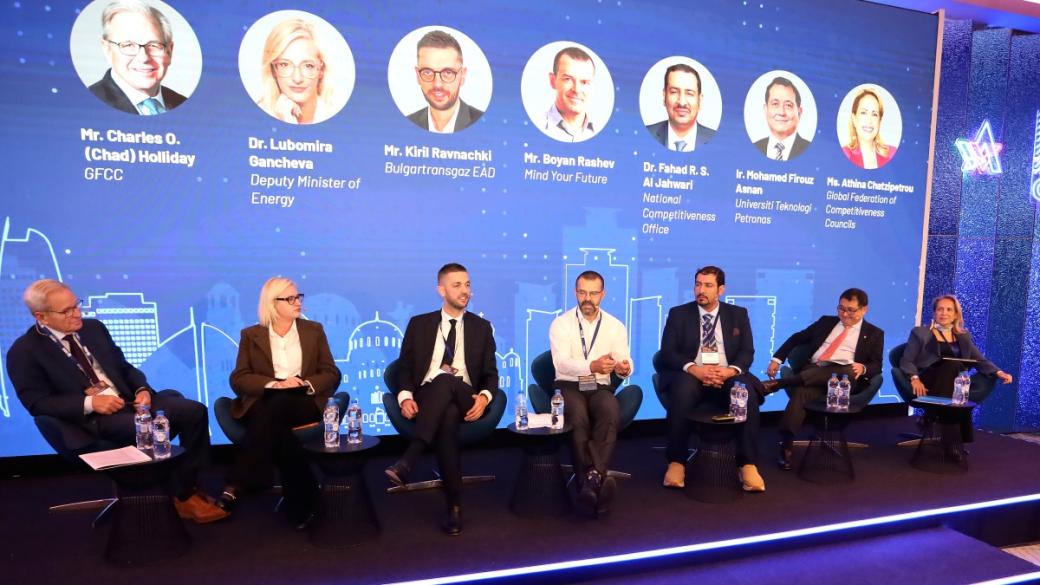
The event took place on October 20, 2026 and the Global Federation of Competitiveness Councils (GFCC) and Glavbolgarstroy jointly organized it. The panel “Energy Security and Independence: Building Resilient Economies” featured Deputy Minister of Energy Dr. Lyubomira Gancheva, Executive Director of “Bulgartransgaz” Kiril Ravnachki, energy expert and founder of Mind Your Future, Bojan Rashev; the Director of Oman’s National Competitiveness Office, Dr. Fahad Al Jahwari; the President of Universiti Teknologi Petronas in Malaysia, Mohamed Firuz Asnan; and the GFCC representative from Greece, Athina Hatzipetrou. The federation’s chairman, Charles Holiday, moderated the discussion.
Bulgaria Is Preparing a New Approach to Energy Planning
Deputy Minister of Energy Lyubomira Gancheva outlined the need for Bulgaria to transition from isolated measures to address challenges in the sector to a comprehensive framework for long-term energy planning.
According to her in recent years the main focus has gradually shifted from the availability of energy resources to their affordability, and the next important step is to build a sustainable energy system capable of responding to future shocks.
We have moved from the availability of energy to its affordability. Now in my opinion sustainability is the next key pillar on which we must focus,” Gancheva noted.
She explained that the government is working to consolidate existing measures within the framework of a long-term energy strategy based on modeling and various scenarios for the sector’s development. The idea is to ensure predictability for investors and industry as well as for households.
In this context the deputy minister also highlighted the liberalization of the electricity market for residential consumers as one of the key issues for the coming year. According to her such changes must take into account the protection of households and the need for a stable and predictable energy environment.
Gancheva also drew attention to the expected increase in electricity consumption, driven in part by the growth of industry, data centers and artificial intelligence. In her words national energy plans must also take into account infrastructure development in neighboring countries so that investments can be planned within a broader regional context.
No one should have to go it alone. The costs of energy resources and infrastructure must be shared when there is a common plan,” she emphasized.
According to the deputy minister Bulgaria possesses significant expertise in nuclear energy, as well as opportunities for developing renewable energy capacity combined with storage systems. To ensure the necessary specialists and investments over the coming decades it is important that the future energy mix be clearly defined now.
Gas Interconnections and the Role of the Vertical Corridor
The need for closer regional cooperation was also emphasized by the CEO of Bulgartransgaz, Kiril Ravnachki. According to him the recent upheavals in the energy markets have shown that diversifying suppliers is not enough if countries do not also have alternative routes through which natural gas can reach consumers.
The recent disruptions have taught us that even if we have a diversified portfolio of natural gas supplies, we must also have a variety of routes so that in the event of an interruption we can continue operations by choosing another option,” he noted.
As an example Ravnachki highlighted the Vertical Gas Corridor project, which aims to provide additional natural gas transmission capacity between Greece, Bulgaria and the countries to the north. According to him transmission capacity from Greece to Bulgaria has already been increased by 40% and the expansion toward Romania is expected to provide an increase of nearly 90%.
Ravnachki emphasized that the effective use of existing infrastructure, combined with the removal of existing network constraints, can improve liquidity in the gas market and strengthen competition among suppliers.
He noted that energy security requires the coordinated development of various infrastructure elements — liquefied natural gas (LNG) terminals, gas pipelines and gas storage facilities. In his view cooperation among operators creates the conditions for Southeast Europe to become an increasingly important part of the continent’s energy security.
Energy prices remain a challenge
Energy expert Boyan Rashev emphasized the affordability of electricity and the need for European policies to take into account the real needs of the economy. He noted that the average exchange price of electricity in Bulgaria for delivery on October 20 reached about €300 per MWh — a level that, in his view, raises serious questions about the industry’s competitiveness.
Rashev expressed the view that over the past two decades the European energy debate has placed too much emphasis on environmental sustainability while security of supply and affordability have not received sufficient attention.
According to him the Bulgarian energy system continues to rely on power plants using domestic lignite when serious difficulties arise or consumption increases. This he said highlights the need to find long-term solutions that balance energy security and environmental goals.
Rashev also noted that the advent of artificial intelligence and increased computing power will lead to additional demand for electricity. Therefore he argued Europe must make better use of its available energy resources while simultaneously developing new technologies.
Shale Gas and Critical Raw Materials
Questions from the audience also directed the discussion toward opportunities for exploring local energy and mineral resources. When asked whether the government is considering lifting the ban on the use of hydraulic fracturing in shale gas exploration — introduced in 2012 – Deputy Minister Lyubomira Gancheva stated that the government has not yet discussed the issue.
However she expressed a willingness to engage in dialogue regarding technological developments and the possibility of discussing specific projects in collaboration with the Ministry of Environment and Water while taking into account the potential environmental impact.
On the topic of critical raw materials Gancheva noted that the Ministry of Energy and the government are actively working to develop this sector, which is also important for energy security. She noted that the Bulgarian Energy Holding (BEH) is already working on a project in this area.
As a reminder, on January 1, 2026 BEH, the Bulgarian Academy of Sciences (BAS) and “Mini Maritsa-East” signed an agreement to explore the possibilities for extracting critical raw materials and rare earth elements from lignite in the Maritsa Basin. Among the raw materials being studied are germanium and graphite; drilling has been carried out and additional sample analyses are planned in the US to help assess the potential for economically viable extraction.
Gancheva emphasized the need for cooperation between institutions and the business sector to advance research on critical raw materials, including finding solutions that take environmental requirements into account.
International Experience
International participants presented various approaches to energy security depending on the economic characteristics and resources of individual countries. Athina Hatzipetrou, the GFCC representative from Greece, emphasized that energy can no longer be viewed solely as a standalone sector, as prices and supply security directly affect inflation, investment and competitiveness.
According to her Southeast Europe is gradually strengthening its role as a strategic energy corridor for the European Union, and gas and electricity interconnection projects between Greece, Bulgaria and other countries in the region are creating additional opportunities for diversification.
For his part Dr. Fahad Al Jahwari presented Oman’s perspective, where energy security is closely linked to geopolitical stability in the Middle East and the reliability of international supplies. He highlighted the country’s efforts to diversify its economy beyond traditional oil and gas production. Among the priorities is the development of green hydrogen; according to the ambitions he outlined, Oman aims to produce approximately 1 million mt annually by 2030.
The President of Universiti Teknologi Petronas, Mohamed Firuz Asnan, examined the relationship between energy security, technological development and human capital. He cited Malaysia as an example, noting that alongside the production and export of energy resources the country is developing its electronics industry and striving toward more sophisticated and high-tech manufacturing.
According to him having sufficient energy resources is no guarantee of economic success if countries lack qualified specialists to use them effectively.
Energy security is also human capital security,” Asnan pointed out, noting that building a power plant can take about five years while training a qualified energy engineer requires a significantly longer period.
Summarizing the discussion GFCC Chairman Charles Holiday emphasized the importance of long-term planning and the ability of energy companies to respond to various scenarios. As an example he cited Shell’s practice of using scenario planning not so much to accurately predict the future as to build readiness for various market and technological changes.
Translated with DeepL.