Simona Gotsova
Public Finances
Eurostat has confirmed: Bulgaria has exceeded the permitted budget deficit for 2025
Only a European derogation, under which certain expenditures will be excluded from the final calculation, will “save the day”
~ 3 min read

Bulgaria ended 2025 with a deficit well outside the European rules on fiscal discipline, which require it to be no more than 3% of gross domestic product (GDP). According to data from the National Statistical Institute (NSI) and the European statistical office Eurostat, last year the deficit on an accrual basis – i.e., including accrued expenses even if they have not been paid – was 3.5%.
Meeting the deficit criterion was one of the conditions for the country to be admitted to the eurozone. And continued compliance with the criteria, even after accession, is important to demonstrate stable public finances and an economy.
Incidentally, inflation is the other indicator showing a deterioration in recent months, with the average price increase in Bulgaria exceeding 4 percent in March, driven by rising energy costs due to the crisis in the Middle East.
According to Eurostat estimates, the deficit a year earlier was 3%, and in 2023 – 2%.
Bulgaria’s accrual-based deficit for 2026 (2022 – 2025)
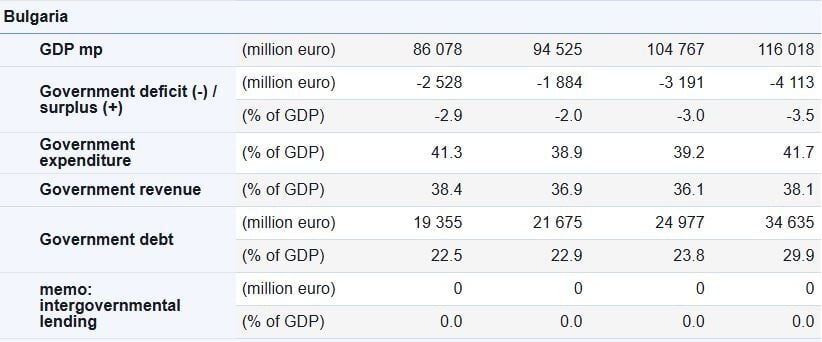
Table: Eurostat
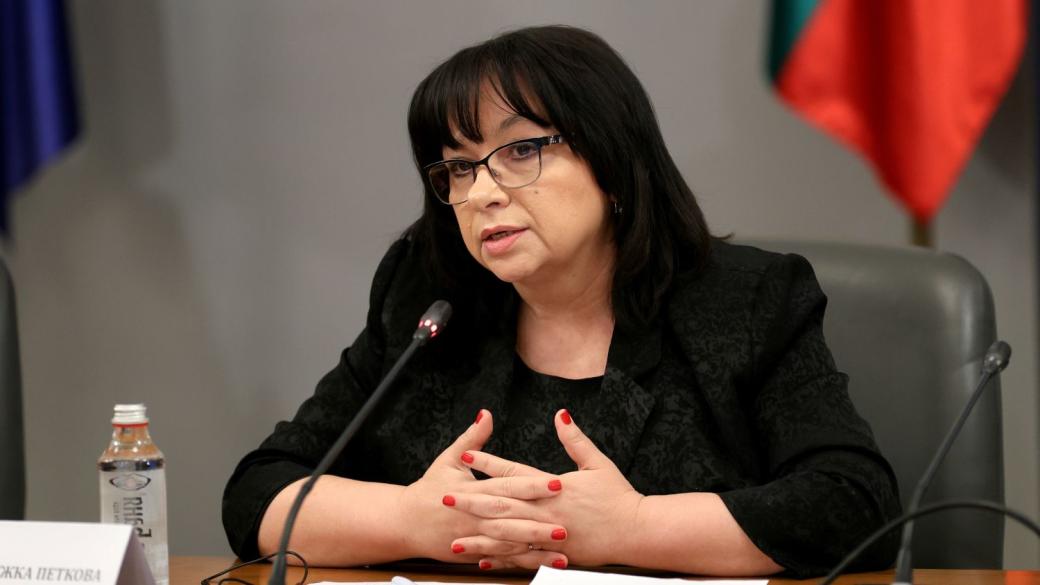
We remind you that data from the Ministry of Finance indicated a 3.1% cash-based deficit in 2025. The ministry, then still led by Temenuzhka Petkova (GERB), noted that this was a “minimal deviation of just 0.1 percent from the forecast GDP.”
In fact, the poor Eurostat data had been anticipated by analysts and economists. For months, the Fiscal Council has been warning that this steady rise in public spending in recent years is creating strain in a system that is inertial.
The budget covers these deviations and problems, but when the trend takes over, things become visible,” said Lyubomir Datsov of the council in a comment to Economic.bg.
“Relying on revenue projections that do not reflect economic reality is one of the main reasons for this huge discrepancy,” he noted a few days ago in an interview with Euronews.
We remind you that one of the main criticisms of the 2025 state budget, drafted by the now-defunct “Zhelyazkov” coalition government, was precisely the unrealistically projected revenue growth. In the end, this resulted in the largest shortfall in tax revenue (excluding social security contributions) since 2009.
When you do foolish things and try to explain how much you care about the people, the only result is that, in the end, the people foot the bill,” added Datsov.
Is Bulgaria at risk of an excessive deficit procedure?
The only thing that could help “patch up” the situation is the Euroderogation for military spending. With it, up to 1.5 percentage points of military spending can be removed from the deficit calculation.
In fact, the data published today “are part of the first 2026 notification to Member States under the Excessive Deficit Procedure (EDP), prepared based on the European System of National and Regional Accounts (ESA 2010),” Eurostat notes.
Their estimates indicate that in 2025, almost all member states reported a budget deficit, with the exception of Cyprus, Denmark, Ireland, Greece, and Portugal, which recorded a surplus. The largest deficits were recorded in Romania (7.9% of GDP), Poland (7.3%), Belgium (5.2%), and France (5.1%). A total of 11 Member States have a deficit equal to or exceeding the reference value of 3% of GDP.
Translated with DeepL.