NRIC lays the conceptual groundwork for three intermodal terminals in Bulgaria
Three individual companies and two consortia submitted bids in the tender
© ECONOMIC.BG / ChatGPT
~ 4 min read
 Gloria Hristova
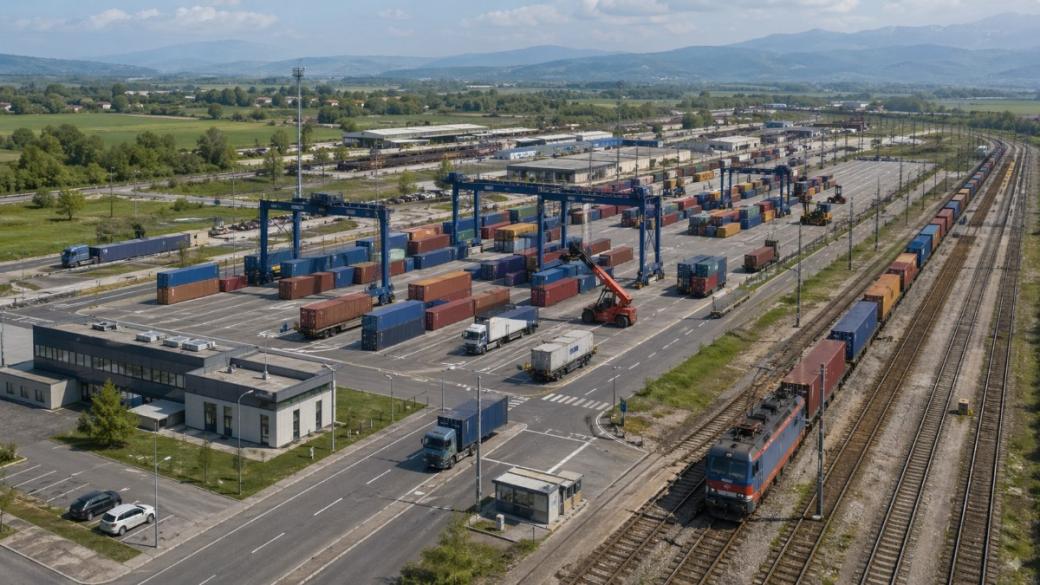
 Five candidates – three individual companies and two consortia – have expressed interest in preparing the analyses, conceptual designs, and plans for the three new intermodal terminals in Sofia, Gorna Oryahovitsa, and Vidin. This is evident from the opened bids in the tender issued by the National Railway Infrastructure Company (NRIC) with an estimated value of over 5.2 million euros excluding VAT.
We remind you that the tender was launched on February 16, with a deadline for submitting bids on April 17. The bids were opened on April 20, according to information from CAIS. The participants’ price proposals will be disclosed at a later stage.
The contract is divided into three separate lots – one for each intermodal terminal. The estimated value for each lot in this procedure is just over 1.7 million euros excluding VAT. This contract has been announced without secured funding.
The activities outlined in it involve the preparation of preliminary studies, conceptual designs, detailed urban plans, preparation for expropriation procedures, and technical specifications. All of this is intended to lay the groundwork for future engineering contracts (i.e., design and construction) for the intermodal terminals.
We recall that as early as the beginning of last year, it became clear that NKZI plans to launch the procedure. This was evident from preliminary announcements posted on CAIS.
The terminals in Sofia, Vidin, and Gorna Oryahovitsa are not new. They were planned years ago, but contracts for them were never announced. We recall that the one in Gorna Oryahovitsa was included for funding in the first versions of the Recovery and Resilience Plan, but was subsequently dropped from it in favor of the one in Ruse.
Their actual construction is to be funded by the “Transport Connectivity” Program 2021–2027. At least that was the latest information from late 2025.
This is partially confirmed in the documentation. It states that an application for funding under the European program is pending, but only for the terminals in Gorna Oryahovitsa and Vidin. Another source of funding will be sought for the intermodal terminal in Sofia.
The construction of intermodal terminals in these areas will contribute to improving intermodality in freight transport, as well as help improve transport security and safety,” the technical specification states.
Who are the candidates?
The same five participants submitted bids for all three positions.
All bids were submitted on April 17, i.e., on the last possible day for doing so. They are: Contractors will have450 calendar days for all activities specified in the procedure. These are strategically important in terms of site selection and the future value of the projects.
- “Eurotransproject” Ltd.;
- “Cheh Project” Ltd.;
- “Transgeo” Ltd.;
- “Infra Nova” Consortium (with lead partner “Infra Pro Consult” Ltd.; no information is available on the other participants);
- Consortium “IMT Infra” (with participants “InfraCAD” Ltd., “Infrastructure Construction” JSC, and “Team 2000 - Kotov S-Ie SD”.
Activities
The work of the future contractors is divided into six precisely defined work centers, which will take the project from a purely theoretical concept to full readiness for the upcoming construction contracts.
In the first phase, the focus is on analyzing the current infrastructure and forecasting traffic loads. Designers are required to conduct a traffic analysis with a horizon of at least 30 years, taking into account two scenarios—with and without the construction of the terminal. To ensure the forecast is as realistic as possible, the documentation requires conducting surveys among national and regional carriers, freight forwarders, and businesses, who must specify exactly what services they need.
One of the most critical aspects of the contract is selecting the exact location. Within 70 days of the contract’s start, contractors must propose at least three alternative options for each terminal. The criteria are strict: proximity to manufacturing centers, quick access to highways and the railway network, and a mandatory requirement for state- or municipally-owned properties. The goal is to avoid environmental burdens and “Natura 2000” zones that could “block” the implementation of the projects at a later stage.
Once the location is approved, the next step is to prepare the conceptual investment project and the detailed development plan (DDP). Here, the National Railway Infrastructure Company (NRIC) requires not only technical drawings of the track layout and transshipment yards, but also modern visualizations – 3D images and animations – to show how the facilities will look in a real-world setting. Designers will have to detail everything: from the main gates and warehouses to the container repair facilities and security systems.
A key element of the contract is the economic and legal modeling of future operations. Contractors are tasked with preparing a “cost-benefit” analysis in two versions. The first will examine the project solely from the perspective of the state beneficiary, while the second – the so-called “extended analysis” – will explore the possibilities for public-private partnerships (PPPs) or concession agreements. The state wants to see realistic scenarios for how a private operator could take over the management of the terminals, analyzing the financial flows and risk allocation over a 30-year period.
Translated with DeepL.