MRDPW Wants to Make Non-Compliant Infrastructure Projects “Tolerable”
Over 630 million euros have been set aside for index-linked advance payments, Regional Minister Ivan Shishkov announced
© ECONOMIC.BG / Economic.bg
~ 5 min read
 Gloria Hristova
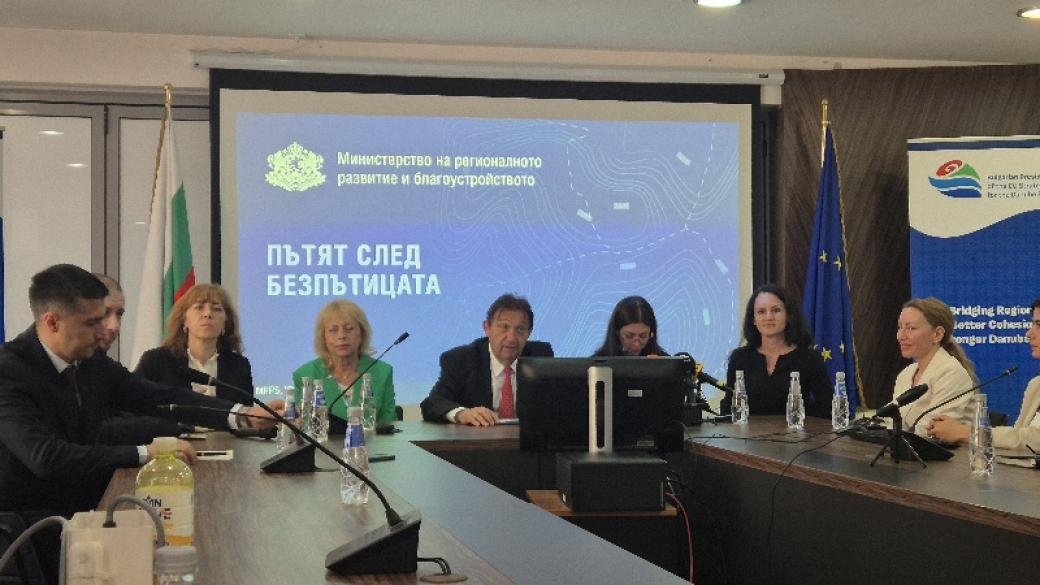
 Risk of losing EU funds, over 630 million euros blocked that were earmarked for indexing construction advance payments, and a new proposal for “tolerance” regarding infrastructure projects. These were the highlights of Regional Minister Ivan Shishkov’s press conference, during which he once again noted that the construction of major road projects in the country has slowed alarmingly.
Grace Period for Infrastructure Projects
The issue of tolerance arose in connection with the construction of the Hemus Highway, whose sections are currently being built ostensibly by the state-owned “Autostrade.” In reality, however, the work has been subcontracted to third-party companies under the guise of contracts for equipment rental and material supply.
Furthermore, for several weeks now, Regional Minister Ivan Shishkov has been engaged in a public dispute with former Minister Ivan Ivanov over whether there is illegal construction on Lot 4 of the highway and whether the building permit issued by Ivanov actually violates legal regulations. Shishkov has repeatedly pointed out that illegal construction was discovered on this lot several years ago.
It is precisely in addressing this issue that the minister sees the introduction of so-called “tolerance” – a special procedure that would allow for the legalization of infrastructure projects built without proper construction permits – as a solution to the problem. The idea is limited solely to infrastructure projects – not national ones, but municipal ones – and the minister presented it as the only realistic way out of the accumulated legal chaos.
Perhaps this tolerance – limited to infrastructure projects and genuine, not like the one in Varna – will most likely be a matter for further discussion and approval, so that we can resolve this issue while addressing all the responsibilities the state has incurred in connection with illegal construction,” Shishkov said.
He added that if the prosecutor’s office, to which he filed a complaint, decides to revoke the building permits already issued for the disputed lots, the solution will once again involve tolerance.
That is not the minister’s intention. We recall that he proposed this in his capacity as caretaker minister and introduced amendments to the Spatial Planning Act (SPA) in the 48th National Assembly. These amendments were rejected by nearly all political parties. At that time, projects with non-compliant construction documentation were estimated to be worth over 1 billion leva and included sections of the Hemus Highway, major road repairs carried out under the guise of routine maintenance, and dam repairs.
The proposed changes at the time called for a comprehensive inspection of each project, the issuance of a technical passport, and mandatory insurance—the cost of which to the state was never specified. The procedure would have been equivalent to commissioning. Industry organizations warned at the time that the changes could exacerbate the problems rather than solve them.
Indexation of Advance Payments Totaling Over 630 Million Euros
Over 632 million euros had been earmarked for indexation of advance payments on the “Hemus” highway lots, the Vidin–Botevgrad expressway, and for landslide stabilization, the minister revealed. These amounts were to be added to the advance payments already disbursed for these projects.
As a reminder, the “Zhelyazkov” cabinet adopted a new methodology for indexing construction contracts at the end of last year. In May, Shishkov criticized it and announced that he was suspending payments, and the ministry published a new methodology for public discussion.
The minister described this as “not a petty theft, but a government-sanctioned robbery by a former government” and stated that contractors would have to earn their payments based on the originally agreed-upon amounts.
The good news is that construction companies are apparently no longer seeking this advance payment. There’s no way those who were prepared to take that money... I’m not saying they should steal it, because at the end of the day, someone was going to give it anyway. The one who gives it is at fault, not the one who wants to take it.”
According to information released by the ministry, index-adjusted advance payments totaling nearly 423 million euros were earmarked for the “Hemus” project, just over 113.7 million euros for the “Vidin – Botevgrad” expressway, and over 95.6 million euros for landslide stabilization.
What is the status of the major projects?
Regarding “Hemus,” Shishkov painted a picture of complete lawlessness and construction absurdities. While there has been physical progress on Lots 2 and 3, the situation in the remaining sections is critical.
For Lot 4, over 12 million euros have been paid for illegal construction, even though there isn’t even an open construction site. Even more scandalous is the situation with Lot 6, where, according to the minister, he had already identified a clear sham of activity years ago, with equipment parked as if in a “car dealership.” The routes for Lots 7 and 8 are yet to be redesigned.
Despite the lack of actual work on all these sections – including the infamous “lot in the bags” (Lot 5) – huge advance payments were disbursed. It was precisely on these lots that the state was going to apply the now-suspended index adjustments.
The minister described the Vidin – Botevgrad expressway as “an absolute nightmare and disgrace” – construction is moving extremely slowly, and in three entire lots, it hasn’t even started.
Shishkov emphasized that the state had deliberately avoided complex projects – such as the Southern Arc of the Sofia Ring Road and the Kresna Gorge – because “when a project is complex, no one wants to deal with it, but when there’s money to be made, everyone rushes to get to work.” Projects such as the Petrohan Tunnel and the “Black Sea” and “Rila” highways are in the very early stages of contracting.
The government has more highway design projects to complete than have actually been built to date – this is a failure we do not deserve,” the minister stated categorically.
European Funds at Serious Risk
The overall picture is compounded by the critical situation with European funds. The “Regional Development” program is experiencing a catastrophic delay – only 56% of funds have been contracted, and a shocking 14% have actually been paid out in the fifth year since its launch. The risk of losing European solidarity funding amounts to nearly half a billion euros.
To salvage at least 300 million euros, the ministry has agreed with the European Commission to change the reporting approach through the “expenditure-independent financing” mechanism.
Additionally, preparations are underway to transfer completed municipal projects from the Recovery Plan to the program in order to generate expenditures by the fall.
At the same time, an internal audit has revealed serious manipulations and subjective criteria in the procedure for small and medium-sized enterprises in coal-mining regions. This has forced the European Commission to categorically refuse funding for this measure. Currently, the Ministry of Regional Development and Public Works is seeking a legally sound way to restart the process so that businesses in Stara Zagora, Kyustendil, and Pernik do not lose the allocated funds.
Translated with DeepL.