Construction of the highway through Kresna toward Sofia is now underway
Nearly 35% of the city bypass is complete
10
Photos
© ECONOMIC.BG / RIA
~ 5 min read
 Gloria Hristova
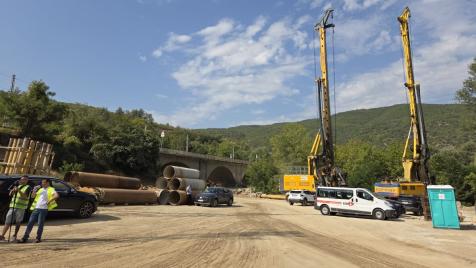
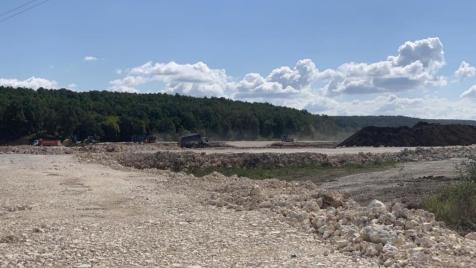
 Construction of the Kresna bypass – the first major milestone in the construction of the Struma Highway through the Struma Gorge – is proceeding on schedule. According to the latest data from the Road Infrastructure Agency (API), nearly 35% of the construction work has been completed to date.
This large-scale infrastructure project, which began on November 27, 2025, aims to divert heavy transit traffic away from the city center, thereby improving traffic safety. The 4.2-kilometer section is part of the larger Lot 3.2.2. Construction and installation work on the bypass itself is expected to be completed within two years.
Against this backdrop, construction work through the gorge could begin as early as this year. According to a written response from Regional Minister Ivan Shishkov, heavy machinery will be deployed on-site in stages during the fall and by the end of 2026, with work focusing on the left lane (in the direction of Kulata – Sofia) and the construction of the Kresna bypass, which, according to the project, is part of the right lane (toward Greece).
Engineering Progress on the Bypass
The builders’ work is focused on the five major structures in the section – three bridges and two tunnels. According to the Road Agency, underground excavation work is progressing at a good pace. In the “Kresna 1” tunnel, 143 meters (out of a total of 359 m) have already been excavated, and in “Kresna 2,” 60 meters (out of a total of 231 m).
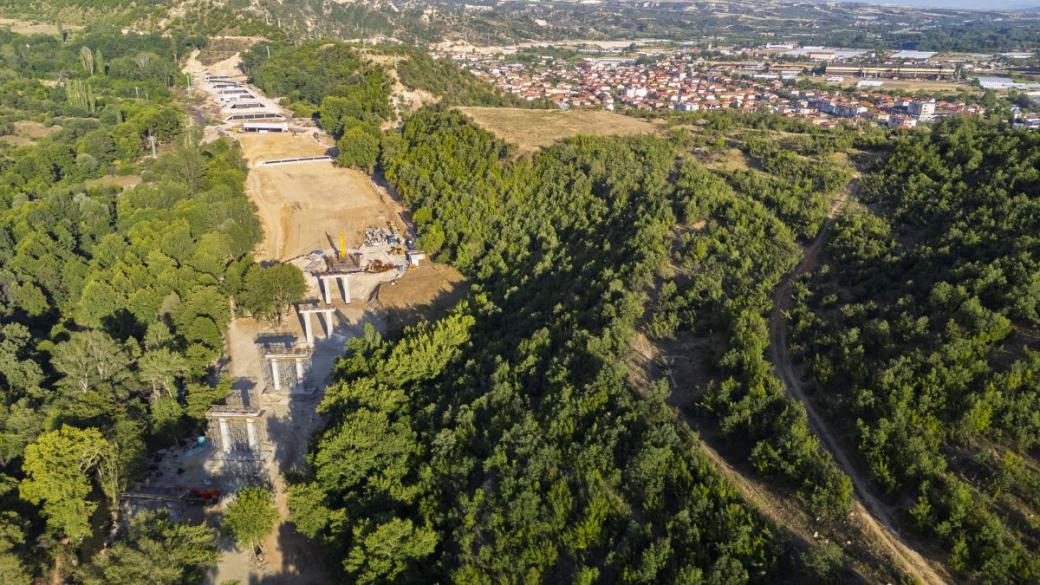
Significant work is also underway on the bridge structures. Beams are being installed on the two bridges spanning the Struma River (298 m and 296 m long), and pile foundations are being constructed on one of the structures. The third bridge, which will cross the Vlahinska River, will be 203 meters long.
The Kresna bypass is being built to G 10.50 specifications (two lanes). The first 200 meters of the bypass coincide with the existing Class I highway I-1 (Sofia – Kulata), after which the route branches off onto an entirely new alignment. It will pass east of the town, in close proximity to the “Tisata” Nature Reserve, crossing the Struma River, the railroad line, and the first-class highway at two points.
The environmental aspect of the project is also in an active phase. Reconstruction of the affected power lines has been completed, and work on the irrigation canals will begin after the end of the irrigation season. At the same time, agricultural crossings and specialized wildlife crossings are being built to ensure the safe passage of wildlife in the area.
At the end of the bypass route, a phased connection to Highway I-1 is planned, as well as the construction of a large-scale rest area. It will feature a commercial zone and capacity for nearly 100 vehicles, including 50 parking spaces for heavy-duty trucks and buses.
The Big Picture: What’s Happening with the Route Through the Gorge?
While construction is underway on the bypass, at the institutional level, the government is trying to make up for years of delays on the remaining sections. According to a response from Regional Minister Ivan Shishkov on June 11, the goal is to complete the entire 23-kilometer section between Krupnik and Kresna (Lot 3.2) by mid-2029.
The section passing through the Kresna Gorge is divided into two lots – 3.2.1, 13.2 km long, and 3.2.2, 10.4 km long. The second lot also includes the Kresna bypass. According to the plans, Lot 3.2.1 primarily covers the construction of the left lane (traffic heading from Kulata to Sofia). Lot 3.2.2, however, is a sort of “2-in-1” contract – it includes both the completion of this left lane before the town and the Kresna bypass itself, which will handle the right lane (transit traffic from Sofia to Greece).
For the first lot, the Road Infrastructure Agency (API) selected a contractor at the end of 2019. The selected consortium is “APP LOT 3.2.1,” comprising “Groma Hold,” “European Roads,” “Water Construction – Blagoevgrad,” “Patroject,” and “Vahostav-SK.” The contract value is nearly 306 million euros, including VAT.
For the second lot, at the end of 2020, the consortium “AM Struma – 3.2.2.” was selected as the contractor, with participants “GBS – Infrastructure Construction,” “EPOS – Empresa Portuguesa de Obras Subterrâneas,” and “Glavbolgarstroy International.” The contract value is just over 291 million euros, including VAT.
Both contracts were signed by Ivan Shishkov in 2023 in his capacity as acting regional minister, but they contained provisions explicitly stating that construction must be carried out in a way that does not hinder the possibility of building a second lane in the direction from Sofia to Kulata outside the Defile – an issue that had divided environmentalists and the government for years.
We recall that real progress became possible after the historic compromise in February 2025, when the government and environmental organizations reached a consensus. The roadmap adopted by the Council of Ministers calls for both lanes of the highway to be rerouted outside the Kresna Gorge, with the current road remaining as an alternative. To this end, in January 2026, the Road Infrastructure Agency (API) signed a contract to develop a conceptual design for diverting transit traffic, and environmental impact assessments are currently being prepared.
However, to avoid wasting time, the government has given the green light to the already contracted sections of the left lane (Kulata – Sofia direction):
- The remainder of Lot 3.2.2: This contract includes both the Kresna bypass currently under construction (right lane) and a section of the left lane. A Detailed Development Plan for the route outside the bypass itself has already been approved (as of February 2026). Expropriation procedures are currently underway, and provided there are no appeals, actual construction there could begin in September of this year, Shishkov notes in his response;
- Lot 3.2.1: The technical design has been approved; approval of the parcel plans and the issuance of a building permit are pending. Construction and installation work on this 13-kilometer section may begin by the end of 2026.
The “bottleneck” near Simitli remains a key challenge
One of the most critical issues for the overall operation of the highway remains the 2.7-kilometer section near Simitli (Lot 3.1, from km 373+300 to km 376+000). This is the “missing link” that is supposed to connect the already completed section of the “Struma” highway with the future route through the gorge.
Work there was blocked due to the Simitli Municipality’s refusal to approve the initial design. Local authorities insisted that traffic to and from Bansko and Razlog be completely routed outside the city limits.
This forced the Road Infrastructure Agency (API) to develop a new conceptual design, including a redesign of the “Simitli-East” interchange. To expedite the process, on April 30, 2026, the Road Infrastructure Agency launched a direct negotiation procedure (worth over 90 million euros) with the consortium that built the main portion of the lot. The goal is to divert traffic via direct, conflict-free connections, with a completion deadline of 240 days for design and 365 days for construction (following the completion of land acquisitions).
Resolving the Simitli interchange is a prerequisite for the Kresna bypass – which is currently under construction—and future sections of the highway to effectively handle transit traffic to our southern neighbor.
Translated with DeepL.