
The Cabinet Puts Bulgaria’s Small Airports on the Agenda
The tunnel near Vakare will lose European funding due to major delays in the project
© ECONOMIC.BG / BTA
~ 7 min read
 Gloria Hristova
 The government will try to revive Bulgaria’s small airports, but without pouring millions into expensive and unprofitable equipment.
Against this backdrop, however, the Ministry of Transport is forced to urgently “rescue” major railway projects, removing the troubled tunnel near Vakare from European funding, while the struggling Bulgarian State Railways (BDZ) and Bulgarian Posts are already undergoing 45-d crisis audits.
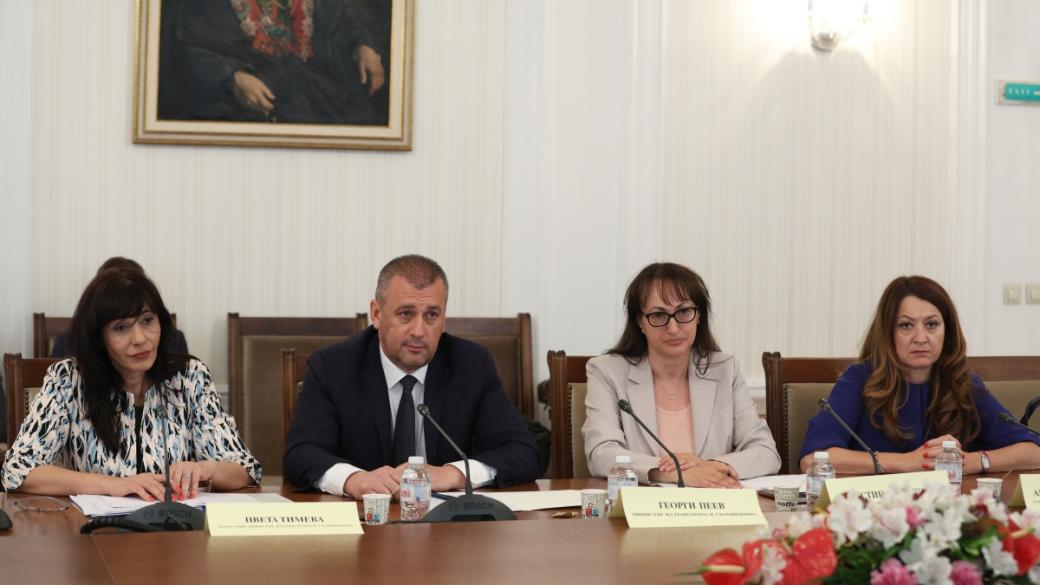
These are the main highlights from the rapid review conducted by Transport Minister Georgi Peev before the Parliamentary Committee on Transport and Communications.
Before the MPs he and his team acknowledged the serious legacy problems in the railway sector and the state postal service, promising solutions based solely on facts and figures rather than on emotions.
An Opportunity for Small Airports
A key focus during the hearing was the concept of revitalizing regional airport complexes to stimulate economic recovery and tourism. Minister Peev emphasized that Bulgarian airspace is among the busiest in Europe, but ground capacity must be developed strategically.
According to him Plovdiv Airport has potential not only as a cargo hub but also as an intermodal terminal. Pre-concession analyses, initiated by previous governments, are currently underway.
Let us wait for the results so we can assess whether they are adequate and whether they could serve as a basis for a concession or a public-private partnership,” the minister commented.
We would like to remind you that the issue of the Plovdiv Airport concession has been on the agenda for years. Last June it became clear that Italian companies were interested in the project. The previous “Zhelyazkov” government had planned for the concession process to begin either at the start or in the second half of this year, but that never happened.
Regarding the airport in Gorna Oryahovitsa the minister said that the concessionaire has solid plans for its development. We recall that the consortium “Gorna Oryahovitsa Civil Airport,” in which the state held a 5% stake, received the concession in 2016. For most of the past decade the company “Kristalna Voda,” indirectly linked to Rumen Gaitanski-Vulka, controlled the airport.
Last year however ownership changed and the airport concession passed into the hands of Kiril Klenovski, who through his “Gorna Oryahovitsa Airport Project Company” assumed full control of the facility.
The goal is to resume commercial flights as early as this fall. The plan calls for extending the runway, which will rank it third in the country. The main focus will be on cargo services, the construction of a long-term aircraft maintenance facility and an intermodal terminal, but local authorities are also hoping for charter flights to short-haul destinations.
Regarding Ruse Airport the minister commented that it is municipally owned, but the ministry will assist the municipality if there is a sound and adequate business plan for its development.
We recall that on September 30, 2025 the airport operator (“Airport Ruse,” represented by Hristo Krusharski) officially submitted the General Development Plan to the city’s mayor, Pencho Milkov. In the long term infrastructure is being prepared to accommodate large passenger aircraft such as the Airbus A320 and Boeing 737. The real innovation there, however, is the construction of a specialized zone for unmanned aerial vehicles and the prospect of a partnership with the Bulgarian company Dronamics for cargo drone transport.
Minister Peev commented thatthe Stara Zagora airport is being developed as part of an economic and industrial hub. Recently Minister of Economy Alexander Pulev told BTV that the former airport will not operate as a traditional standalone airport. With funding from the Just Transition Fund it will be transformed into a large-scale industrial zone. The idea is to restore the runway to accommodate small aircraft, drones and cargo flights, which will serve as an alternative supply route for future investors (primarily from the automotive and defense sectors).
The concept of building an airport complex and hub is also being applied to the former airport near Dobroslavtsi, with the ministry promising to support and initiate the processes.
Just a month ago (in May 2026) the government announced the urgent unfreezing of the “Dobroslavtsi” Economic Zone. After nearly three years of administrative stagnation the scope of the large 290 ha site was expanded. In addition to investors in the automotive industry the zone will now seek to attract leaders in innovation, defense and space technology.
When we talk about revitalizing an airport it is important to clarify what we mean by that. For small projects it is not cost-effective to purchase expensive equipment; they serve different needs. Investments by municipalities and private users must be minimal but provide the greatest possible added value,” Peev stated emphatically, adding that the ministry will support and initiate these processes.
The Vakarel Tunnel Is Being Removed from the EU Program
The most significant delay in the railway sector is observed in the Elin Pelin – Kostenets megaproject. Deputy Minister Tsveti Timeva acknowledged that the first section (Lot 1), where the critical Tunnel 2 (in the Vakareel area) is located, cannot be completed within the eligibility period for expenses under the “Transport Connectivity” Program.
The tunnel must definitely be removed from the scope of the project so as not to halt construction on the entire lot and to prioritize the sections where work can begin immediately,” Timeva explained.
Due to changes in technical solutions and delays this complex project will have to be completed entirely at the expense of the state budget, Timeva added.
Minister Peev also commented on the current working methodology at the National Railway Infrastructure Company (NRIC). According to him it has been common practice to sign contracts for projects without first completing land acquisition procedures, geological surveys and archaeological studies.
The contract is signed, then there is a huge period of time during which nothing is done, and by the time actual implementation begins, circumstances have already changed, there are requests for indexation and delays pile up like an avalanche.”
Currently the actual absorption of funds under the “Transport Connectivity” Program stands at just 27%, even though 80% of the resources had been contracted as of May. Peev announced that projects without secured funding will not be launched and efforts are being directed toward those with a realistic prospect of implementation and toward safety. The minister was adamant that funding would be sought through European programs to implement projects.
Regional Connectivity
The minister announced that he is leaving for a key meeting in Thessaloniki with his Greek counterpart and the European Commissioner for Transport. The focus will be on North-South vertical connectivity and the trilateral memorandum between Bulgaria, Romania and Greece.
There are also specific initiatives related to military mobility for the Silistra – Calarasi route, so we may have some good news for you a little later,” the transport minister hinted.
Analysis of “Ivkoni Express” and Audits in the Sector
Addressing lawmakers’ concerns regarding the contract with the private carrier “Ivkoni Express” – which, at the end of 2025, took over 25% of the country’s rail transport without prior experience in rail transport – Peev assured that a comprehensive audit is underway.
The investigation has been commissioned and will be comprehensive. Since the contract takes effect at the end of the year we still have time to respond. I am a flight instructor and manager – someone who speaks in facts and figures. I cannot commit to a specific date, but the results will be presented in a timely manner if action needs to be taken,” he emphasized.
At the same time, targeted 45-d audits have been scheduled at “BDZ Holding,” “Passenger Transport,” “Freight Transport,” the National Railway Infrastructure Company (NRIC) and “Bulgarian Post,” where the financial and operational situation is most dire.
A Critical Summer for BDZ and the “Free Fall” of Bulgarian Post
The Ministry of Transport is facing a logistical nightmare for the summer of 2026. BDZ’s rolling stock dates back to the 1960s and 1970s. The modern German trains that were purchased meanwhile do not operate well at temperatures above 35°C, for which scientific solutions are being sought in collaboration with the Bulgarian Academy of Sciences (BAS) and the Technical University, Peev commented.
According to the minister an additional complication is that the new trains under the Public Procurement Act are already arriving in batches but the government has not yet initiated the procedures for building the mandatory automated depots needed to service them.
No less alarming is the situation at Bulgarian Posts, whose total liabilities amount to nearly €135 million.
I do not have a specific plan at the moment, because to stop something’s free fall, you first need to know what its actual condition is,” Peev admitted candidly.
He was, however, adamant that the restructuring would not mean closing post offices in villages due to their key social function.
Do not expect sudden, emotionally driven moves. No one intends to bankrupt Bulgarian Post,” the minister concluded.
Allocation of Responsibilities and a Fourth Deputy Minister
Minister Peev also presented the allocation of responsibilities within his team, emphasizing that the scale of the sector necessitates the appointment of one more deputy minister. Currently the tasks are divided among three deputies.
Tsvetana Timeva (former Chief of Staff to the President with experience in construction and road infrastructure) will take on the most problematic portfolio – rail transport, which Peev described as the ministry’s “Achilles’ heel.”
Hristina Velinova (a former deputy minister and advisor with many years of experience in Brussels) will be responsible for aviation, international affairs as well as the Executive Agency “Automobile Administration” (DAI) and the Civil Aviation Administration.
Anna Natova will take charge of water transport and international projects.
The ministry’s leadership has made an official proposal to create a position for a fourth deputy minister who will focus on road transport.
Translated with DeepL.
