Real estate transactions in Bulgaria have plummeted
While real estate agents speak of "normalization," official statistics on sales for the first half of the year show levels not seen since 2020
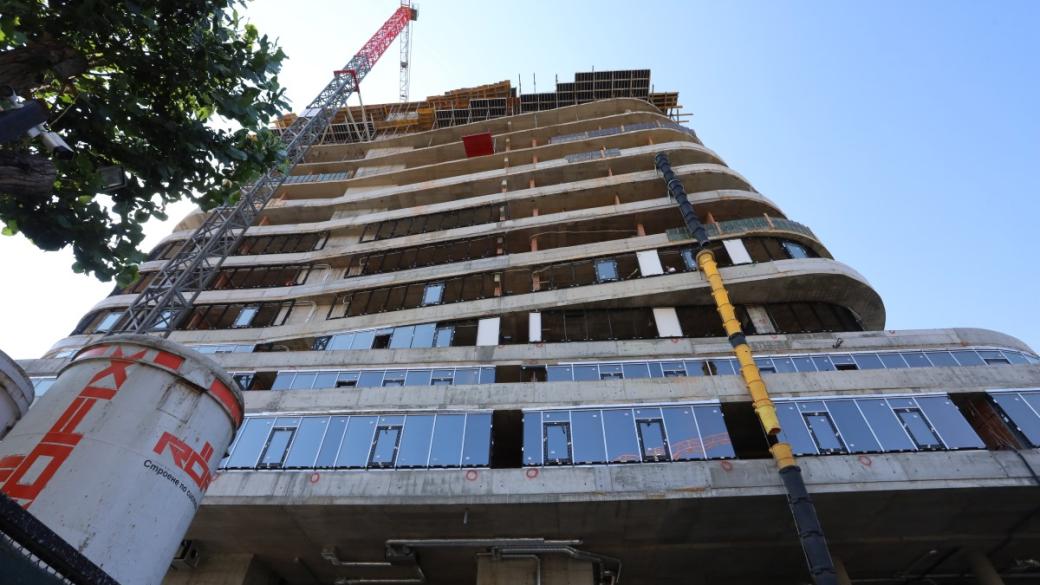
© ECONOMIC.BG / Krasimir Svrakov
~ 6 min read
 Gloria Hristova
 A massive decline or an expected stabilization? This question will continue to divide experts and analysts in the Bulgarian real estate market in the coming months. The Registry Agency published the long-awaited data on the number of real estate transactions in the second quarter of 2026. The data show that there were a total of 45,965 sales in the country, a 17.9% decline compared to the same period last year. Leading real estate agencies, however, interpret the statistics as growth, since they compare the second-quarter data with that of the first quarter.
This increase was expected, as the spring quarter is traditionally more active than the winter quarter, but it fails to offset the accumulated annual decline. Aggregate data for the entire first half of 2026 show an overall market decline of nearly 17% year-over-year, making the January – June period the weakest for the sector since the pandemic began.
All these figures point to a shift that has begun in the market. In fact, some agencies had already cautiously noted this trend at the beginning of the year. Experts at the time reported observing the first signs of a “turnaround” in the real estate market, marked by a shift toward a potential oversupply in certain areas of Sofia.
Following the release of statistics for the first quarter of the year – which showed the first double-digit declines in total sales volume on a year-over-year basis – market participants predicted that this was a temporary lull due to the introduction of the euro (on January 1), and that activity would recover in the spring.
The Second Quarter of 2026
The data for the second quarter can be interpreted in two ways. On the one hand, real estate agencies report a return to normalcy. According to an analysis by “Adres,” the market has entered an anticipated phase of stabilization but is far from expectations of a dramatic upheaval. The company emphasizes that the second quarter saw an 18% increase in Sofia, Plovdiv, Varna, and Burgas compared to the first three months of 2026.
The major upheaval that many had speculated about did not materialize. The second-quarter data prove it – the market is entering a more moderate phase, which is a healthy development following the boom of 2023 – 2025. Activity in April, May, and June compared to the beginning of the year shows a proportional trend identical to that of previous years,” commented Gergana Tenekedzhieva, CEO of “Adres.”
She added that the comparison with 2019 covers the entire country, while in the four major cities the situation is different, and they remain at the levels seen during the active year of 2023. The company also reports that discounts are offered in 54% of transactions (typically 10%), and 70% of purchases in Sofia are financed with a mortgage.
However, if we broaden the scope of the analysis beyond a comparison of two consecutive quarters (Q2 versus Q1 traditionally always shows growth due to the spring season) and look at the data on an annual basis, the picture reveals a sustained decline in transaction volumes.
Here is how the volume of sales and purchases for the second quarter (April–June) has looked over the years: Even if we assume that 2025 was an exceptional year due to the excitement and investment frenzy surrounding Bulgaria’s entry into the eurozone, and compare the results with the same period in 2024, the decline is again significant – 15.5%.
- 2026: 45,965 transactions;
- 2025: 56,010 transactions (pre-euro peak);
- 2024: 54,379 transactions;
- 2023: 54,371 transactions;
- 2022: 63,928 transactions (absolute post-pandemic peak);
- 2020: 37,903 transactions (COVID lockdowns);
- 2019: 52,503 transactions (pre-pandemic reference year).
The data unequivocally shows that the market has contracted by 12.4% even compared to the “normal” year of 2019. Expectations that the euro would trigger a new wave of speculation have collided with the reality of depleted purchasing power and the price ceiling that has been reached. As a reminder, Bulgaria ranked second in the EU in terms of housing price increases at the start of 2026.
The Real Picture: The First Half of 2026
Looking at just one quarter always carries the risk of statistical distortions. But when we combine the raw data for the first and second quarters, we get a crystal-clear picture, free of seasonal variations.
During the first six months of 2026, a total of 84,119 real estate sales were completed in Bulgaria. If we compare this figure with previous years, the scale of the decline becomes evident. During the same period in 2025, there were 101,154 transactions, representing a sharp decline of 16.8%. In years of market stability, such as 2024 and 2023, transaction volumes consistently hovered around 98,000 for the six-month period.
The current slump, however, has a much more significant implication – it has pushed activity below the baseline set in pre-pandemic 2019 (when there were 92,506 transactions).
Regional Contrasts
Although the decline in activity is widespread, the country’s four major real estate markets are reacting at different speeds and with varying dynamics. Data for the second quarter, supplemented by the trend for the entire half-year, paint a varied and highly revealing picture for each of the major centers.
Sofia – A Significant Slowdown in the Largest Market
In the second quarter of 2026, the capital recorded a 16.7% year-over-year decline, with reported sales falling to 8,874 (compared to 10,647 a year earlier). This indicates that even the most liquid market in the country is experiencing a sharp contraction in transaction volumes this spring. The trend is confirmed and further underscored by data for the entire first half of the year – a total of 16,403 transactions were recorded for the first six months. This represents a 14.7% decline from the record 19,235 for the same period in 2025, and brings the capital significantly below 2024 levels (16,939).
Plovdiv – An Island of Stability
At the other end of the spectrum is Plovdiv, which once again proves itself to be the most resilient major market in the country. The decline in Plovdiv during the second quarter was limited to just 6.7% (3,848 transactions compared to 4,136 in 2025). This resilience is also reflected in the data for the entire half-year, where Plovdiv recorded the smallest decline among the major cities – just 4.7% (from 7,618 to 7,258 transactions). By comparison, this volume is extremely close to the normal levels seen in 2023 (7,415) and 2024 (7,455). The region’s economic and industrial dynamics, internal migration, and a more balanced ratio between incomes and property prices are clearly keeping this market significantly closer to the surface.
Varna – Deep in “Red” Territory
The maritime capital moved in perfect sync with Sofia during the second quarter, recording an identical decline of 16.7% (3,077 transactions were registered). Although this indicates a slight stabilization in the rate of decline compared to the exceptionally difficult winter months, the market remains deep in “red” territory relative to data from previous years. This is confirmed by the overall picture for the six-month period: for the first half of the year, Varna contracted by nearly 19% (from 6,794 to 5,510 transactions). This result is particularly alarming from a historical perspective – transactions in Varna are currently even lower than in pre-pandemic 2019, when there were 5,689 transactions in the first six months.
Burgas – A Major Correction
The most alarming signals are coming from the southern Black Sea coast, specifically from Burgas. That city has suffered the hardest blow among the major centers – a drop of nearly a quarter (23.7%) in transaction volume for the second quarter, falling to just 1,818. The figures for the first half of the year are just as stark – sales volume for the six-month period plummeted by over 21% (to 3,325 transactions, down from 4,225 a year earlier). If we look back at the trend, it is clear that Burgas has lost a huge portion of its market volume compared to years of strong interest, such as 2024 (4,151 transactions). This market, which for a long time was fueled by intensive new construction on greenfield sites and speculative interest in vacation properties, is clearly the first and biggest victim of the market’s sobering up.
Translated with DeepL.