The design of the Petrohan Tunnel will proceed in parallel with the environmental assessments
Preparations for this large-scale project are proceeding on an extremely tight schedule so that the expressway can be proposed for a public-private partnership as soon as possible
© ECONOMIC.BG / AI Generated
~ 3 min read
 Gloria Hristova
 The long-awaited Montana – Sofia expressway project, featuring a tunnel under the Petrohan Pass, is proceeding on an extremely tight schedule. To minimize delays the government is changing its previous approach and will carry out the design work in parallel with the rigorous environmental procedures. This became clear from a response by Regional Development Minister Ivan Shishkov during parliamentary oversight on Friday. He assured that the institutions are working intensively to make up for the delay.
Procedures for Two Routes Simultaneously
As a rule the design phase begins only after the final route has been selected through the Environmental Impact Assessment (EIA) procedure. However to save years of administrative delays the Ministry of Regional Development will commission engineering-geological surveys and a preliminary design even before the Ministry of Environment makes its final decision.
Minister Shishkov explained the rationale behind this decision, emphasizing that the time factor is more important than a potential slight increase in costs.
Concurrent with the environmental procedures work will begin on an expanded conceptual design, a detailed master plan and the necessary engineering-geological surveys. “I have requested that the design work begin, even though the EIA procedure is just getting underway. Even if we have to design both routes – which will slightly increase the cost of the project – time is of the essence for us.”
The project is currently at a key stage of its preparatory phase. After the Expert Council of the RIA approved two alternative routes for further consideration, the environmental procedure was initiated. The contract with the contractor who will prepare the EIA reports and the Assessment of Compatibility with Protected Areas is expected to be signed in August.
The procedure will conclude with an EIA decision, which, if all stages proceed normally, is expected to be finalized in mid-2027.
The deadlines we have set for ourselves are nothing like past practices – they will be extremely tight,” Shishkov stated.
Regarding the construction itself the government plans to seek private investors. The minister confirmed that the state will provide an opportunity for implementation through a public-private partnership, describing it as the fastest way for the project to move forward.
The only issue that could slow us down is potential appeals against the procedures. Nothing else will stop us. We are working extremely intensively,” the regional minister stated emphatically.
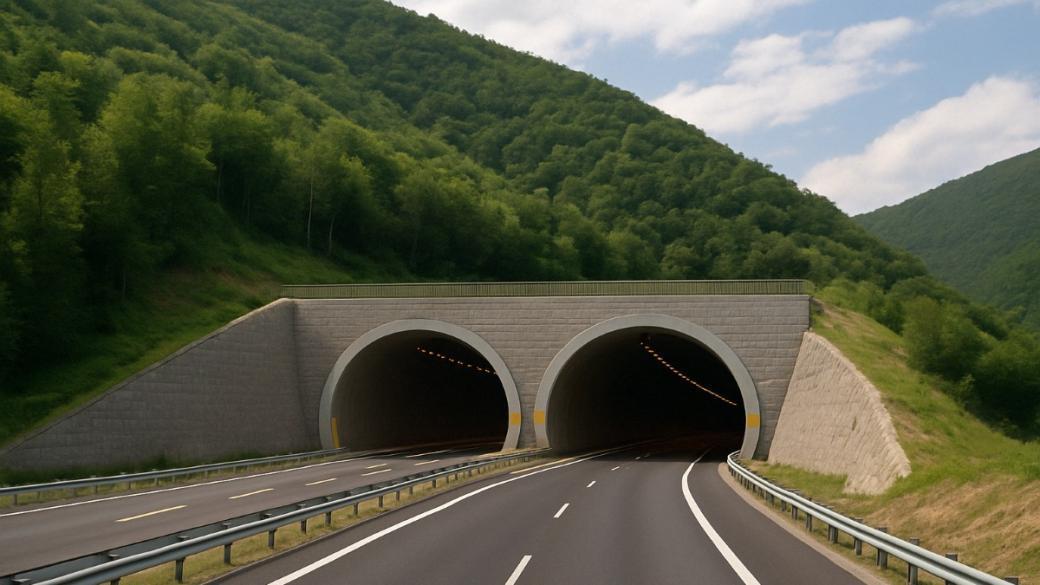
As a reminder the RIA has left two route options under consideration, rejecting the shortest and least expensive option (a 7.2 km tunnel). Under both remaining options the future facility will consist of two separate tubes with one-way traffic, and the expressway will allow speeds of 120 km/h.
- “Dark Blue Option”: This option calls for a shorter total route (approximately 95.7 km) but a record-breaking 14.03 km tunnel. The ascent into the Stara Planina Mountains will begin between Varshets and Spanchevtsi. Its estimated cost is over €1.1 billion.
- “Green Option”: The total route is slightly longer (99.4 km), but the tunnel is significantly shorter – 10.05 km – since the road climbs to a higher elevation before going underground. It is estimated to cost approximately €818 million.
The main challenge to the project’s implementation remains the route’s proximity to protected areas within the “Natura 2000” network (such as “Western Balkans” and “Ponor”), as well as to sanitary protection zones for drinking water sources. This is precisely what makes a thorough environmental assessment the most important factor for the future of the expressway.
Translated with DeepL.