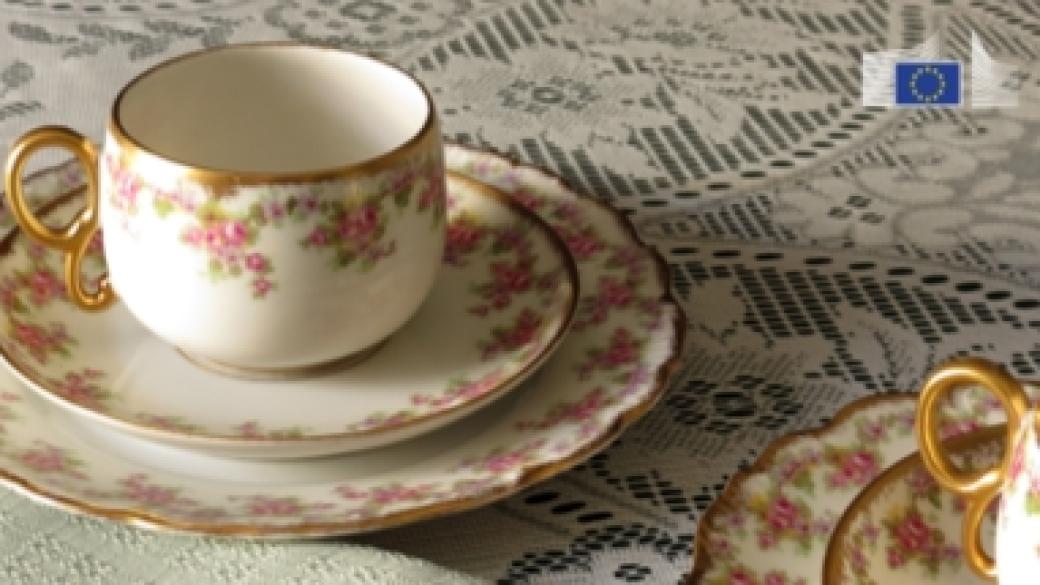
Europe has protected its first artisanal product: French Limoges porcelain
The new European CIGI system extends market protection – which until now has mainly applied to wines and cheeses – to cultural and industrial heritage
~ 2 min read
 Economic.bg
 French porcelain from Limoges (Porcelaine de Limoges) has become the first artisanal and industrial product to receive official protection as a Geographical Indication (GI) at the European Union level. This marks the first actual application of the new European CIGI system (craft and industrial products with a geographical indication), according to the European Commission’s Directorate-General for the Internal Market, Industry, Entrepreneurship, and SMEs (DG GROW).
The registration comes less than six months after the official launch of the application procedure on December 1, 2025.
What does the new protection entail?
Until now, the EU’s geographical indications schemes have long protected the names of primarily agricultural products. The new framework builds on this successful model but extends it to Europe’s artisanal and industrial heritage.
A geographical indication ensures that a specific name can be used only for authentic products produced in a defined geographical area, whose qualities and reputation are directly linked to that region.
The system provides producers and consumers with strong legal safeguards against unauthorized use of the trademark, imitations on the domestic and international markets, or misleading claims regarding origin.
The European Commission reports strong initial interest in the scheme. To date, a total of 74 applications for registration have been submitted from various member states. Among the most active countries seeking protection for their regional products are France, the Czech Republic, Portugal, Slovenia, Slovakia, and Sweden.
The list of pending applications illustrates the richness of European traditions, covering a wide range of products—from ceramics, textiles, and embroidery to cutlery and other iconic crafts.
With the first geographical indication already registered and protected at the EU level under the new CIGI scheme, we have reached an important milestone for Europe’s industrial and cultural heritage,” said Stéphane Séjourné, Executive Vice-President of the European Commission responsible for Prosperity and Industrial Strategy.
He emphasized that the long-awaited framework is already delivering concrete results for regions across the Union.
I strongly encourage artisans and businesses to build on this momentum and take advantage of the opportunities offered by this new protection,” added Sejourne.
In addition to preserving traditional know-how, CIGI protection has a clear economic impact. According to EC experts, it supports regional economies by allowing products to stand out in the market, increasing their export potential, and acting as a catalyst for attracting tourism.
Producers wishing to protect their regional products can receive practical support throughout the application process through their national competent authorities, as well as directly from the European Union Intellectual Property Office (EUIPO).
Translated with DeepL.