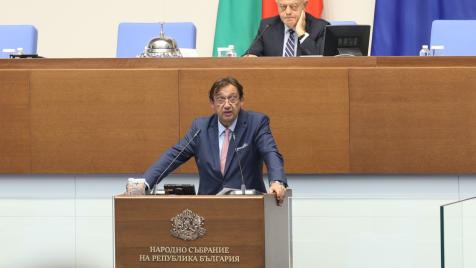
Karadzhov plans two more bridges over the Danube
Bulgaria, Romania, and Greece signed a memorandum on connectivity with an "action plan," but without specifics
~ 4 min read
 Gloria Hristova
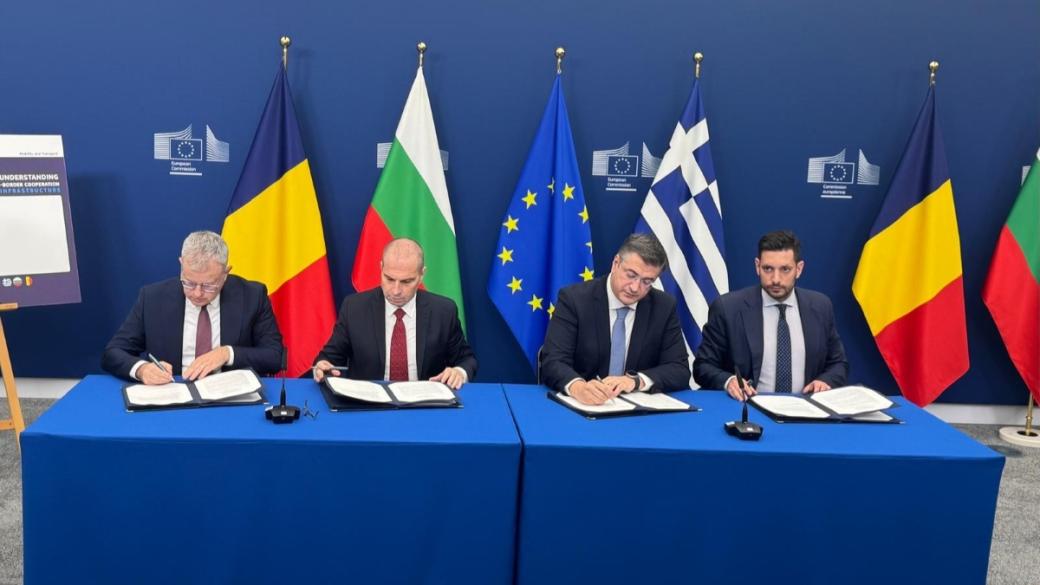
 In addition to the third future bridge over the Danube near Ruse, Bulgaria has ambitions to build two more – near Silistra and Nikopol. To this end, our country, Romania, and Greece signed a Memorandum of Understanding in Brussels. In addition to bridges, the action plan also focuses on upgrading ferry lines on the Danube River and modernizing road and rail connections in three directions.
It is unclear on what basis the projects are planned. There is also no estimated start date for activities such as studies, expropriations, and possible construction and development. The countries will rely on European funds and public-private partnerships to finance these ambitious projects.
We recall that back in October, Bulgarian Transport Minister Grozdan Karadzhov held a meeting with his colleagues from Turkey, Romania, and Greece. At that time, it became clear that a document was about to be signed, which would lay the foundations for the construction of a fourth bridge, in addition to the planned third (note: second near Ruse). The location of the future facility was set to be Silistra – Calarasi. The focus was on the development of the Black Sea motorway project, as well as a second railway line between Svilengrad and Plovdiv and a new railway line between Edirne, Hamza Beili, Lesovo, and Yambol.
The draft memorandum was approved at a government cabinet meeting at the end of November.
The fifth bridge and ferries on the Danube
The press release from the relevant ministry makes it clear that the action plan between the three countries (this time Turkey did not participate) provides not only for the construction of a fourth bridge at Silistra – Kalarash, but also a fifth one at Nikopol-Turnu Magurele.
In practice, Karadzhov is returning to the plans announced during the Petkov government, when a special map showed the construction of bridges at several points along the river – in addition to the future combined bridge at Ruse – Danube Bridge 3, bridges were planned at Silistra, Nikopol, Svishtov, and Oryahovo. It is unclear why the locations in the latter two cities were dropped.
Instead of bridges, ferry lines are planned at Oryahovo – Beket, Svishtov – Zimnich, and Silistra – Calarasi are planned to be "upgraded to dual-use standards to meet the needs of military mobility and provide greater flexibility of transport flows."
However, these ferries stop operating for several hours, especially in bad weather, which prevents navigation on the river. In addition, the access infrastructure on Bulgarian territory is in poor condition.
It is unclear on what basis the projects were selected and planned, as the relevant ministry has not presented any traffic estimates or analyses.
The Danube is the backbone of Europe – the living organism that connects our peoples, markets and ambitions. It is a river and a border, but it should not be a barrier. The new bridges – not just one, but several – are key to the future of the continent, not as bilateral projects, but as European infrastructure that strengthens the single market, ensures military mobility, and makes the North-South axis work," said Minister Karadzhov.
Modernization of railway and road projects
The press release from the relevant ministry does not cite specific railway projects. It only indicates general directions, divided into three axes – western, central, and eastern.
The western axis will connect Athens with Sofia, passing through Vidin and Calafat to reach Bucharest and Central Europe. The central axis starts from Thessaloniki and Alexandroupolis, passes through Svilengrad and Ruse, and reaches Bucharest, and from there to Ukraine and Moldova. The eastern axis connects the Aegean and Black Seas – from Alexandroupolis through Burgas and Varna to Constanta.
It is a new prospect for our ports and will provide alternative routes for trade and mobility," the press release states, although it is unclear whether the Black Sea motorway project is included in the Eastern axis, as was initially announced.
Funding
The three countries are committed to making maximum use of European Union funds from the Connecting Europe Facility until the future multiannual financial framework 2028-2034, the press release said.
We will mobilise public-private partnerships and alternative instruments to accelerate the implementation of projects. Funding will not be fragmented but strategically coordinated so that every investment has the maximum effect for our citizens and businesses," Karadzhov explained.
Why now
The initiative is under the auspices of European Commissioner for Transport and Tourism Apostolos Dziadzikostas, who signed a European Commission Declaration in support of it. It emphasizes that the document is "a decisive step towards faster, more competitive, sustainable, and crisis-resistant connectivity in Southeast Europe."
Commissioner Dziadzikostas said he would work "in close cooperation with the governments of Bulgaria, Greece, and Romania," including through a special working group of experts from the EC and European financial institutions, because in order for all projects to move from plan to real action in the three countries, according to the press center of the relevant ministry.
For decades, the idea of real connectivity between North and South has remained only on paper – without real action. Today, we are beginning to change that, because the commitment we are making is not a symbolic gesture, but a real step towards opening new trade arteries and creating the sustainability that Europe needs," Karadzhov commented.
The document was also signed by Greece's alternative transport minister, Konstantinos Kiranakis, and Romania's state secretary for transport, Ionut Cristian Savoiu.
Translated with DeepL.