Major railway relocation: Over 800 BDZ employees are moving to Ivkoni
The cabinet has authorized Transport Minister Grozdan Karadzhov to sign contracts with operators who will transport passengers
~ 4 min read
 Gloria Hristova
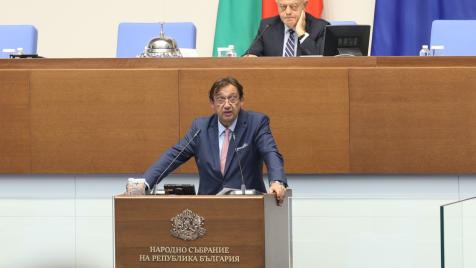
 A total of 813 BDZ employees will transfer to the private operator that will transport passengers from next year – Ivkoni Express. This became clear from a statement by the outgoing Transport Minister Grozdan Karadzhov, who announced after the meeting of the Council of Ministers that he had already been authorized to sign contracts for public rail transport with BDZ - Passenger Transport and the private company.
This is the first time the minister has cited the exact number of people who will change employers. This is due to the conditions set out in the procedure for selecting passenger transport operators in rail transport and the agreements made under the Recovery and Sustainability Plan.
So far, it is unclear exactly how the specific railway workers who will transfer to Ivkoni will be determined.
Karadzhov was quick to reassure everyone that they would retain their positions, pay, and social benefits.
What does this mean in practice?
We recall that a previous press release from the ministry stated that this would happen in accordance with Article 123, paragraph 1, item 7 of the Labor Code. It states that the employment relationship with the worker or employee is not terminated when an activity is transferred or assigned from one enterprise to another.
The application of this legal mechanism means that the 813 employees in question will not go through a dismissal and reappointment procedure. Their employment contracts "follow" the activity that is being transferred. Since Ivkoni Express is taking over the service of the North and South lots, it is very likely that the staff employed in these geographical regions and the respective depots will automatically become part of the new structure.
It is unclear what will happen to people who decide to refuse to switch from a state employer to a private one.
According to paragraphs 2 and 4 of the same Article 123, the new employer is obliged to assume all the obligations of the previous employer arising from the employment relationship on the date of the change. This includes not only salaries, but also accrued leave, seniority, and additional agreements. The code provides for joint and several liability: both BDZ and Ivkoni are jointly liable for obligations to workers that arose prior to the transfer.
We would like to remind you that BDZ-PP and Ivkoni were selected following a procedure initiated by the Ministry of Transport with an estimated value of €1.02 billion (BGN 2 billion) for the next 12 years.
However, when the bids were opened, it became clear that this amount had jumped to over €2.4 billion (BGN 4.8 billion). Neither the evaluation committee, nor the Ministry, nor the Minister saw a problem with the huge exceedance of the indicative price. So far, no one has provided an explanation for what happened.
Although the authorities consider it a success, the expert community remains deeply divided. Prof. Vasko Vassilev, a former advisor to the Ministry, describes the model as "flawed." According to him, dividing the country on a territorial basis kills real competition, as operators will not compete for the same passenger on the same tracks.
Karadjov explained again that every action had been agreed with the European Commission and that the directorates had given positive opinions. The contracts will be signed next week and will enter into force on December 13 this year.
We received a high rating, with no comments, and can proceed to sign the contracts," the minister said.
In addition to the employees, the two operators will also share the rolling stock. The rolling stock purchased after 2009 will be divided on a proportional basis. The rolling stock purchased before that date will be available for hire at market prices determined by an independent appraiser.
According to Karadzhov, the profit of both operators is limited to 3.57%. If a higher profit is generated, the difference will be deducted from the next tranche of the state subsidy.
The Public Transport Act
This "migration" of workers is just one element of the large-scale reform of rail transport, which Karadzhov has linked to conditions for the fourth and fifth payments under the Public Transport Agreement. The cabinet has also approved amendments to the Public Transport Act, which, according to the minister, should put an end to "transport isolation." The bill is expected to be submitted to the National Assembly on Thursday. It provides for:
- National transport scheme: Integration of trains, buses, and even planes into a common schedule, where rail transport is the backbone and buses are "feeder" transport;
- Single electronic ticket: Possibility to travel throughout the country with a single transaction or magnetic card;
- Clearing system: Fair distribution of revenue among the various operators based on actual distance traveled and number of passengers.
I would like to remind you that the EC has doubled its investment in rolling stock, reaching €734 million, which is directly linked to this reform," Karadzhov added.
In the Economic.bg video cast, Prof. Vassilev commented that new, modern trains for 300 people are being purchased under the Recovery Plan (RP), while on many of the secondary lines the average population is only 30-60 people. Thus, there is a risk that taxpayers will pay for something that will not solve the fundamental problem with quality and speed, as the railways remain in poor condition.
This is not a reform on paper, but a real reform that will change the transport sector in Bulgaria and enable us to take the step into the 21st century," Karadzhov concluded.
Translated with DeepL.