Simona Gotsova
Public Finances
The Ministry of Finance found the missing €1.5 billion and will submit the new budget on Monday
Some of the new parameters include maintaining the level of social security contributions and taxes, lower growth of the minimum wage, and cuts in the state administration
~ 4 min read

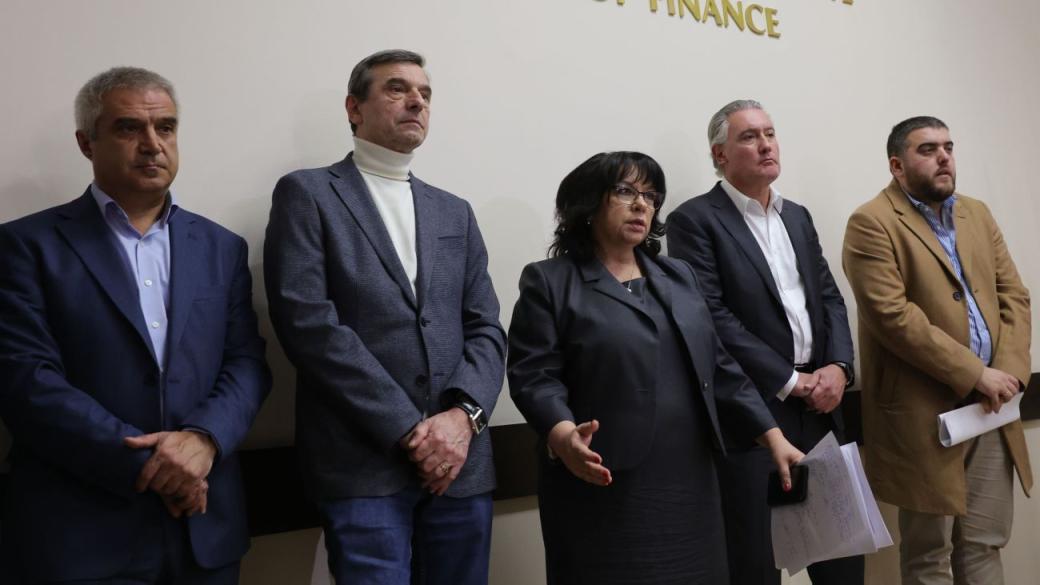
The Ministry of Finance (MF) has managed to find the missing €1.5 billion for Bulgaria's new state budget for 2026, which it plans to submit for consideration to the National Assembly on Monday, December 8. This became clear during a briefing to journalists given by Finance Minister Temenuzhka Petkova and representatives of employer and trade union organisations. Today, the social partners held another meeting to discuss the points of consensus on the new state budget, after the previous one, which sparked the biggest protests since Videnov's time, was withdrawn by parliament.
Trade unions, business, and the government reached agreement on the main parameters of the budget. By the end of the day, the Ministry of Finance will provide the social partners with the draft budget and the updated budget forecast. On Monday morning, there will be a meeting of the National Council for Tripartite Cooperation, and in the early afternoon, the draft budget will be submitted," Petkova said.
She presented some of the parameters of the new financial account, which will also be the first in euros:
- No increase in social security contributions in 2026. The withdrawn version of the budget provided for an increase in pension contributions by 2 percentage points in 2026 and by another 1 percentage point in 2027;
- No increase in the dividend tax from 5% to 10%;
- The requirement for traders to use only sales management software approved by the National Revenue Agency (SUPPO) is abolished;
- The maximum insured income (MOD) will not be €2,352, but €2,300. It is currently €2,112;
- Decoupling of salaries in certain public sectors – more specifically, "Security and Defense" – from the average gross salary. Instead, a general income policy will be applied, which will be 10% for everyone in the public sector. Petkova subsequently clarified that the automaticity will be abolished "for everyone";
- Cutting the capital program – reducing the program by €450 million from national funding and by €300 million in terms of funds from EU funds and programs;
- Total expenditure in the 2026 Budget: 40.1% of GDP.
We will consider it next year
Petkova also touched on the topic of the still unfinished Roadmap for improving the pension system in Bulgaria. As Economic.bg wrote, the document is being developed by six institutions, including the Ministry of Finance and the Ministry of Social Affairs, and was supposed to be ready by November. However, in conversations with employer and trade union organizations, Economic.bg learned that the roadmap has not been presented anywhere at this point and the procedure for it has not been initiated at all.
A significant part of the issues to be resolved in 2026 are related to the roadmap in the social sphere. It will provide answers to many of the questions we have postponed until next year. Together with our social partners, we will seek answers to these questions," Petkova added.
Reform direction
I believe that in the short time we had, we managed to achieve the maximum and create a much better and more balanced budget," commented Kiril Domuschiev, chairman of the Confederation of Employers and Industrialists in Bulgaria (CEIB).
According to him, employers and trade unions have managed "as never before" to find common ground and have met with understanding from the Ministry of Finance and representatives of the political parties in the ruling coalition.
He said that the social partners had agreed to start work on reform measures early next year that would contribute to "an even better budget in 2027."
I hope that the Ministry of Finance will keep its word and that we will start more active communication earlier," he added.
According to him, the 2026 budget plan also envisages reforms, including a comprehensive review of the state administration and a reduction in vacant positions.
There is already some direction for reforms, and I hope it will continue next year," he concluded.
"Our consensus may be a good basis for us to continue working," said Dimitar Manolov from the Podkrepa trade union.
According to him, there must be changes in the state administration, but ones that bring "some real benefit."
The income policy will cost just over €1.4 billion.
How this money will be distributed among the ministries and administrators will be the subject of further discussions," said Lyubomir Kostov from the Confederation of Independent Trade Unions in Bulgaria (CITUB).
However, he pointed out that one of the "unresolved" issues was that of subsidies for public transport in Sofia, Ruse, and Varna, BDZ, and Bulgarian Post.
Rumen Radev, chairman of the AIKB's management board, specified that a three-year program is planned for the gradual elimination of permanently vacant positions in the state administration. The program will cover the period 2026 – 2028.
The idea is to achieve an efficiently functioning administration using modern means," he added.
Translated with DeepL.