Simona Gotsova
Public Finances
Over 800 000 Bulgarians may be left without food vouchers at the end of the year
More and more workers are interested in this social benefit, but the money for it may run out before the end of the year
~ 4 min read

835 000 working Bulgarians who receive part of their salary in the form of food vouchers may be left without them. Tanya Obushcharova, chief secretary of the Association of Food Voucher Operators in Bulgaria, stated this in an interview with Economic.bg. Her concerns are related to the lack of an approved regular State Budget Act for 2 026.
We have serious concerns that by the end of 2 026 the quota will not be sufficient if it remains in this form and is simply converted into euros. It may run out as early as October – November, which means that over 800 000 workers will be left without vouchers in the last months of the year,” Obushcharova said.
She explained that the budget is currently working with the 2 025 quota, which is the same as the 2 024 quota, i.e., BGN 1.6 billion.
We would like to remind you that when the state adopts a new budget for the year it determines an amount (quota) up to which employers can provide the vouchers in question, and this amount is not subject to taxes or social security contributions. The limited amount is distributed among voucher operators and employees receive a tax-free BGN200 per month.
However economists’ estimates indicate that this year the number of voucher recipients could jump to 890 000 – 900 000 due to high interest from both employees and employers.
In other words we are reaching a situation where there are more users, but the tax-free limit is not increasing and is therefore insufficient.
The only way to change this amount is through the regular budget.
At least so far there has been no precedent (editor’s note: for a quota to be increased through an extended budget) and every extended budget law is unpredictable,” added Obushcharova.
Today the caretaker cabinet is expected to submit a bill to the National Assembly for another extension of the 2025 Budget. This time not for a few months but until the adoption and entry into force of the regular budget for 2 026.
Why vouchers are important
The Association’s Secretary General explained that the voucher system is important for workers because it supports their purchasing power and helps increase their motivation and productivity. For employers it is a very good tool not only because of the tax relief but also because it increases the motivation, commitment and loyalty of employees.
I think that there is no longer a job interview where people do not ask about this social benefit,” added Obushcharova.
Separately the amount of BGN 200, or EUR 102.26, is exempt from taxation, i.e. neither the employer nor the employee pays taxes and social security contributions on it. However the disadvantage is that this amount has not been increased since 2022, which is why the Association believes that it needs to be increased.
We believe that it is appropriate and necessary for this amount to be increased. Economists recommend that it be raised to €150 in order to support real purchasing power, which has declined significantly in recent years due to high food inflation,” the spokesperson added.
Incentive to pay taxes
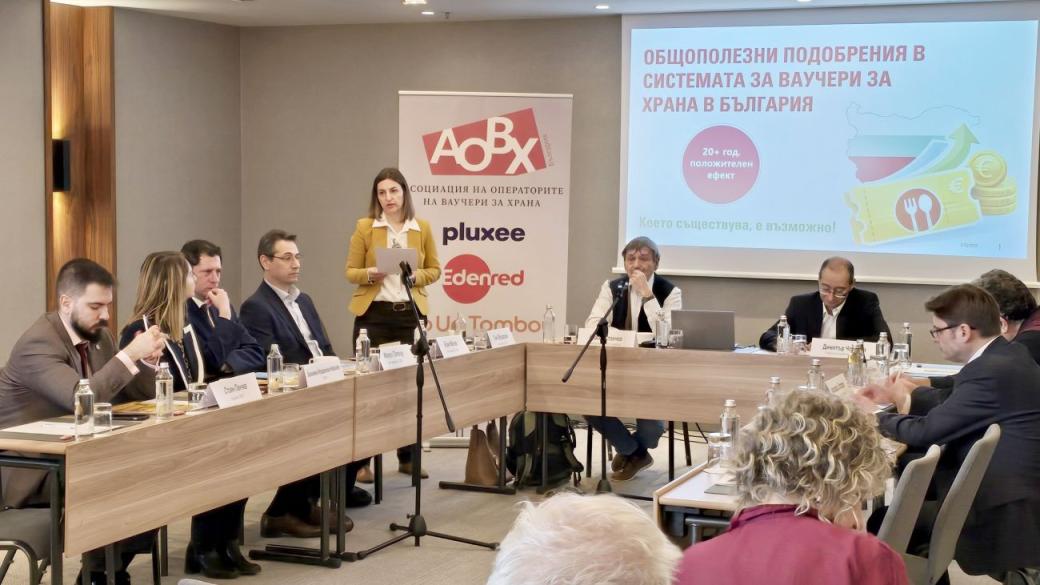
Krassen Stanchev, an economist and lecturer at Sofia University “St. Kliment Ohridski,” explained during an event in Sofia dedicated to the topic that the voucher system has been yielding positive results for over 20 years and is seven times more effective than other social expenditures. A separate advantage is that it provides an immediate return of resources to the Bulgarian economy.
For 20 years there has been no damage to the fiscal system from vouchers but rather positive effects. They have a 15% effect on reducing the gray economy,” Stanchev commented, citing an economic study on vouchers led by him.
He explained that when the system was introduced its volume was 1% of GDP while now this share is decreasing and in 2028 it will fall to 0.6% of the size of the Bulgarian economy.
Therefore one of the economists’ recommendations is that the quota in the state budget should again be 1% and the individual amount of vouchers should be doubled:
- Up to €150 in 2026;
- Up to €200 in 2027.
Even from a macroeconomic perspective it follows that when the total amount of relief (i.e., vouchers) decreases, the incentives for voluntary tax payments also decrease, which has been absolutely obvious for many years,” said the economist.
Less inequality
According to him in a growing economy vouchers not only have an effect on voluntary compliance but also on reducing inequality and the effective tax burden. It turns out that tax payments by both individuals and families have grown faster over the last 10 – 12 years than tax expenditures.
Income growth allows for this orderliness among taxpayers, and this is an important fact in assessing the use of food vouchers,” Stanchev added.
As expected, vouchers have the greatest effect on people with lower incomes – i.e., those receiving wages around the minimum wage (MSW). Dimitar Chobanov, a financier and lecturer at the University of National and World Economy (UNWE), explained that this voucher policy is more effective than making direct expenditures from the budget (editor’s note – for example, through social programs), because the latter requires collection from taxpayers and burdens tax administrations.
They have the greatest effect on people with lower incomes, which can be viewed positively in that their purchasing power increases more. In other words, as a social program, this makes more sense for people with low incomes,” Chobanov explained.
Translated with DeepL.