The domino effect: Every job lost in Pernik’s energy sector puts three more at risk
The results of the large-scale “Mapping 2” study reveal the region’s deep dependence on the energy sector
~ 5 min read
 Gloria Hristova
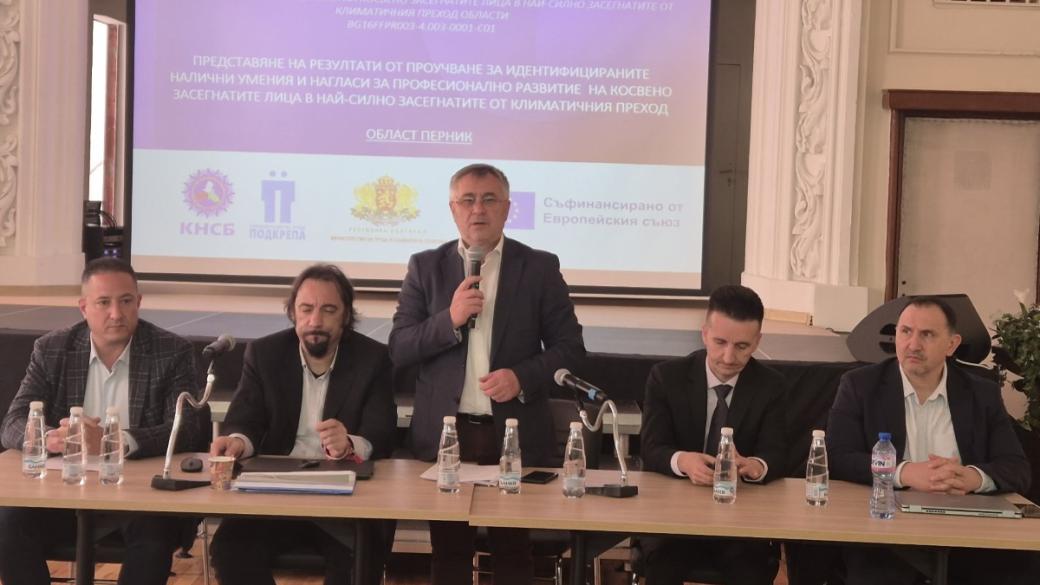
 If we lose one job for a miner or energy worker, three more are automatically lost in the service companies. This cautionary statistic set the tone during an event presenting the results of a large-scale study on indirectly employed persons in the Pernik region.
While the first phase of the mapping covered those directly employed in mines and thermal power plants, the second study shines a spotlight on suppliers, small businesses and the families of energy sector workers.
The mayor of Radomir, Kiril Stoev, and the regional governor, Georgi Nedev, emphasized that the window of opportunity is limited. The main goal is to attract new investors who can “tap into” the region’s existing workforce before the whirlwind of transformation sweeps away economic stability.
Iskren Naydenov from the Ministry of Labor and Social Policy noted that a tremendous amount of work has been done over the past nine months but stressed that for the transition to be smooth everyone must work as a team. He is adamant that financial resources are available but they must be invested in real jobs because without concrete investment plans the social acceptability of the transition will remain a mirage.
Job Losses
Ognian Atanasov of the Confederation of Independent Trade Unions in Bulgaria (KNSB) emphasizes that the ratio of job losses is at least 1 to 3, meaning that for every job lost in the mines or power plants, three more people in the supporting industries are directly at risk.
In the Pernik region the mapping has already covered 6 000 people working in companies that provide maintenance, transportation and logistics for the energy giants. These people represent the first line of “indirectly employed” workers and face risks identical to those of the miners.
Their profile reveals serious demographic challenges, as nearly two-thirds of those surveyed are over 50 yrs old and 77% are over 40.
Violeta Ivanova, Deputy Director of the ISSI at the KNSB, notes that 60% of these workers have more than 11 years left until retirement, which means that natural attrition from the labor market cannot be a solution to the employment problem. It is imperative to create policies to adapt these experienced but aging workers to new economic activities.
The second and third groups in the mapping add even darker shades to the region’s economic picture. A survey by Trend Agency, conducted among over 1 500 people, shows that four-fifths of small businesses in the region – from restaurants to hair salons – identify themselves as affected by the transition.
Mario Ninov of the Podkrepa Trade Union highlights the social time bomb in households where in 30% of cases both the man and the woman work in the energy sector. When 90% of families predict a negative impact on their standard of living, anxiety becomes a key factor in the labor market. People are adamant in their demands, with the vast majority stating that they would not take a new job for a net salary below €1 020 or €1 280.
What jobs would they take?
The mapping data provides a fairly clear, albeit somewhat conservative, picture of the professions people in Pernik are gravitating toward. The main conclusion is that the majority prefers to stay in fields they are already familiar with, with the most frequently mentioned preferred positions being drivers and accountants. This indicates a strong orientation toward professions with direct applicability, which allow for an easy transition to other economic sectors outside of mining and energy.
An interesting detail in the study is the presence of so-called “hidden skills” that workers possess but for which they have no official certification. Many of those surveyed report having experience as welders, locksmiths or mechanics, while on a more informal level skills in the food industry emerge, such as bakers, pastry chefs and food technologists. These are real niches where people would work, provided the state establishes procedures to validate this knowledge so that it becomes legitimate in the eyes of new employers.
Regarding future training the greatest interest is observed in practically applicable fields such as transportation, agriculture, business management and administration. Technical fields in mechanical engineering and metalworking remain dominant over the recently trendy environmental or social sectors, toward which workers in the region still harbor skepticism. Among small businesses and younger professionals there is also some interest in the IT sector and digital skills, but these are viewed more as a supplement to a technical profile rather than as a primary new career path.
Despite these specific examples the study also reveals an alarming fact – nearly three-quarters of respondents in energy workers’ families cannot name a specific desired profession for their future. This uncertainty is not a lack of desire to work but rather a lack of clarity about what exactly will be available on the market in Pernik after the transformation. People are willing to remain in the industrial sector but they expect investors to first present their plans before they themselves take the step toward retraining.
Distrust of Institutions
Although €2.5 million has been allocated to companies in Pernik for upskilling, interest in training remains limited. Only 20% of employed individuals have participated in some form of skills development over the past five years, and the systemic deficit in lifelong learning hinders their adaptation to digitalization and artificial intelligence. The problem is further exacerbated by low territorial mobility as 67% of respondents refuse to move to a different region and half would accept a new job only if it is within a 50 km radius of their home.
The critical level of distrust in institutions is emerging as the biggest barrier to a just transition. People in Pernik understand the need for change but insist that it be linked to stable incomes and institutional reliability.
The project “Mapping the Skills of Indirectly Affected Individuals,” funded by the Operational Program “Regional Development” 2021 – 2027, collected the data. The project aims to identify the real potential of people who do not work in the mines but whose businesses and lives are inextricably linked to the energy sector. The Confederation of Independent Trade Unions in Bulgaria (KNSB) implements the project in partnership with the Podkrepa Labor Confederation with support from the Ministry of Labor and Social Policy.
Translated with DeepL.
Co-Funded by the European Union. Views and opinions expressed are however those of the author(s) only and do not necessarily reflect those of the European Union. The European Union cannot be held responsible for them.