Georgi Zhelyazkov
Regulations
Traikov and Hyundai agree to continue work on the new nuclear units at the Kozloduy nuclear power plant
The contract for the construction of the new units will be renewed even though the price for the large-scale project has not yet been determined
© ECONOMIC.BG / ME
~ 2 min read

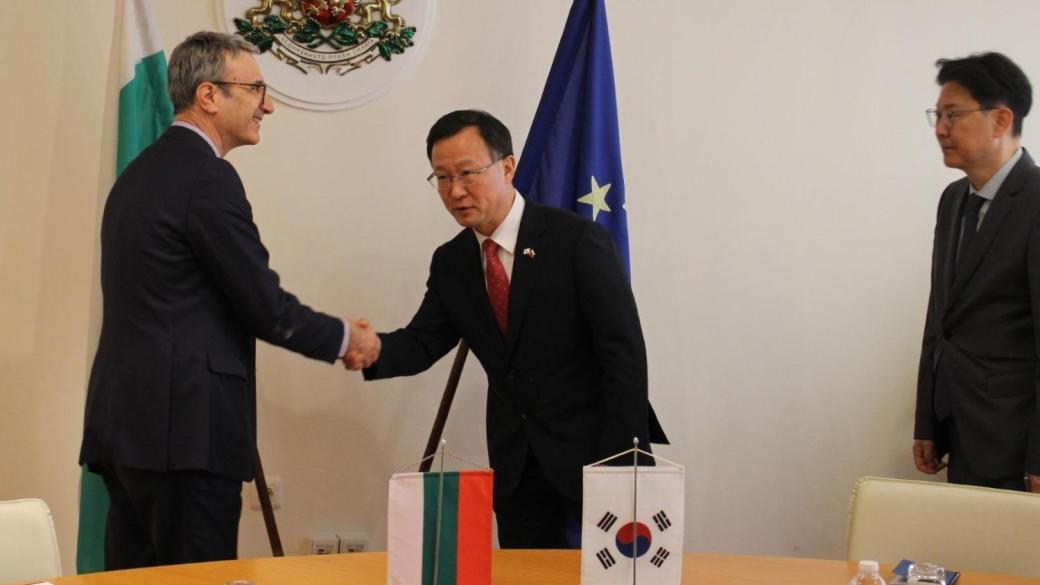
The engineering contract for the construction of the new units at the Kozloduy NPP will be extended. This was agreed upon by Acting Energy Minister Traicho Traikov and the management of Hyundai Engineering and Construction. The previous agreement, signed on November 4, 2024, expired in early March.
Today the parties reached an agreement on the terms for its extension so that work on the construction of Units 7 and 8 at the plant would not be interrupted. To take effect the new contract must be approved by the management of Kozloduy NPP and the Bulgarian Energy Holding, according to the Ministry of Energy.
The contractors from Hyundai Engineering and Construction have emphasized that with the extension of this deadline new engineering activities will be included in the terms so that work on the project does not stop and this does not create a risk of unjustified delays.
We have had a traumatic experience with other similar projects (the Belene Nuclear Power Plant – ed.) where endless extensions and a lack of cost control ultimately led to failure,” said Traikov.
He emphasized the need for the new units at the Kozloduy NPP to be built at fixed prices.
We recall that at the official launch of the project in 2023 when the “Denkov” coalition government was in power. Then-Energy Minister Rumen Radev stated that one of the conditions for building the new units using Westinghouse technology was that the price be fixed at around $14 billion.
At this point neither the price of the reactors nor the price of the electricity produced by the new units is clear. According to a decision by the National Assembly from early 2024 the project’s cost was supposed to be clear by June 2025.
Now Minister Traikov also recalled the Kozloduy NPP’s desire – initially approved by the Bulgarian Energy Holding (BEH) – to purchase 68 decares of land for the project for €100 million – or about €1.5 million per decare. At the time due to strong public backlash BEH withdrew its approval and it subsequently turned out that the land could be acquired through a standard expropriation procedure at a significantly lower price.
As one of the measures against unjustified cost inflation I have officially requested that the land required for the site of the new facilities be expropriated at normal prices,” Minister Traikov emphasized.
Translated with DeepL.