*
* 
Finances
Solar Panels and Batteries: Why Should These Two Technologies Be Viewed as a Single Risk?
© ECONOMIC.BG / REIB
~ 2 min read
This text is included in the digital edition “Leaders in Insurance” 2026, which is part of Economic.bg’s larger project – RATE. In it, we feature leaders in various sectors of the economy, analyze the dynamics in the respective industries, and present market trends – research, analysis, trends by Economic.bg.
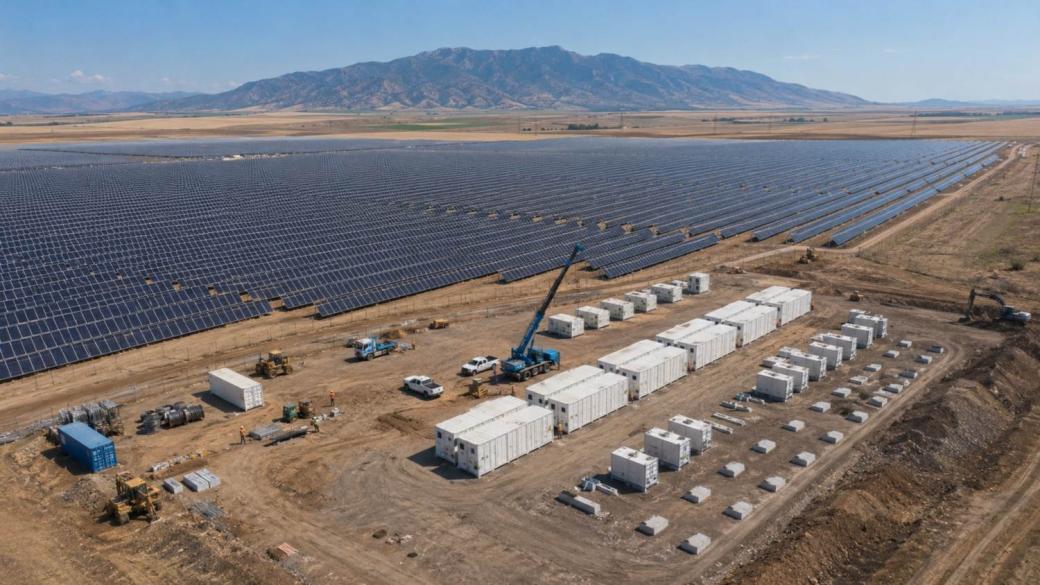
In recent years, co-located projects have gradually become the new standard for renewable energy development in Europe. While the first such projects emerged in markets like Germany and the Netherlands, today the fastest growth is being observed precisely in Central and Eastern Europe. Poland, Romania, and Bulgaria are establishing themselves as some of the most dynamic markets for battery energy storage systems (BESS), and an increasing number of investors are planning photovoltaic plants and batteries as a single integrated system right from the design stage.
As a leader in insuring BESS projects in Bulgaria and Central and Eastern Europe, Renewable Energy Insurance Broker (REIB) observes a clear trend – technologies are evolving faster than risk management approaches.
When a Project Is Managed as Two
Although the solar power plant and the battery system operate as a single asset, they are often still insured separately – with different insurers, terms, and indemnity mechanisms. The problem is that the actual risk does not follow these boundaries.
A thermal event in the battery system can simultaneously affect the batteries, the solar power plant, the project’s revenue, and its financial stability. From a risk perspective, these are not two technologies, but a single interconnected energy asset. The real risk arises after the damage occurs. In many cases, the biggest problem is not the event itself, but what happens afterward.
When different parts of the project are insured differently, questions arise such as: which policy should respond first, how are the financial consequences allocated, and who is responsible for the overall risk.
These are topics that are rarely discussed during project structuring but often become a major issue after a loss occurs.
Why should the insurance strategy start earlier?
More and more investors and banks are realizing that risk management must be part of the project as early as the design phase. This is also the approach REIB takes when structuring the projects it works on. The goal is to develop a consistent insurance strategy for the entire project lifecycle – from construction and testing phases through long-term operation.
It is particularly important to avoid gaps between the construction and operational phases – a period that is often underestimated, even though it is among the most sensitive in terms of risk.
The New Renewable Energy Reality
As the share of co-located energy storage systems grows, these projects are becoming the new reality for the sector. This means that investors, banks, and insurers will increasingly need to view the solar power plant and the battery system as a single, interconnected risk rather than as two separate technologies.
Because when a single incident can simultaneously affect the project’s assets, revenue, and financial model, the question is no longer whether there is insurance, but whether someone is managing the entire risk.
Translated with DeepL.