The Rise of the Bulgarian Automotive Industry: From Component Manufacturer to Future Leader in the Balkans?
The country has the potential to attract a strategic investor for the production of complete vehicles here
~ 4 min read
 Economic.bg
 The Bulgarian automotive industry is facing a historic opportunity for radical transformation. The time when the country was perceived solely as a source of cheap labor and a manufacturer of individual parts is now a thing of the past. Today, Bulgaria possesses the necessary capacity, R&D base, and expertise to take the next logical step – attracting strategic investors for the production of complete vehicles in the country.
This was the main message from the international forum “Automotive Forum Bulgaria 2026: The Future of the Industry, Technologies, and Mobility,” held in the capital.
Data shows that the sector is already a key pillar of the domestic economy – it employs over 80,000 people, and the industry, encompassing over 380 companies and 38 research centers, generates a turnover of over 10 billion euros, accounting for nearly 11% of the country’s gross domestic product (GDP).
A New Horizon for Bulgaria
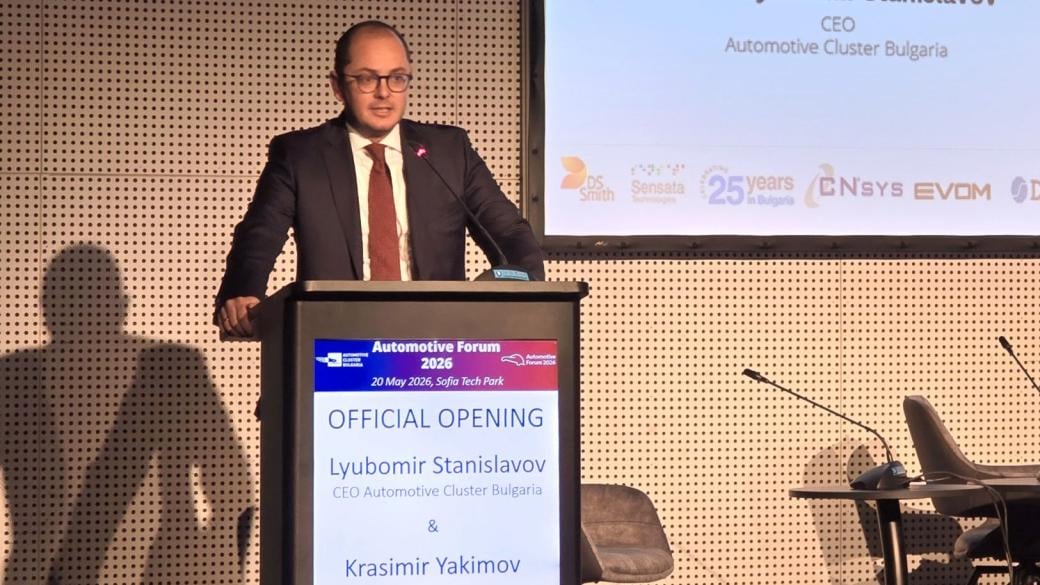
According to business and government representatives, Bulgaria is no longer on the periphery but a deserving participant in the future of the European automotive sector. The Executive Director of “Automotive Cluster Bulgaria,” Lyubomir Stanislavov, announced that the country is entering a new phase, with the first major data center project expected to be presented in the coming months. Even more significant is the forecast that Bulgaria is on track to build its first gigafactory for lithium-ion, electric, and solar batteries.
To realize these ambitions, however, the state must act as a predictable and reliable partner. Deputy Minister of Economy, Investment, and Industry Krasimir Yakimov assured that the government is already developing policies to guarantee:
- Streamlined administrative procedures and modernized infrastructure;
- Prepared industrial zones and long-term tax stability;
- Targeted investments in education, vocational training, and innovation.
Bulgaria can and will be an industrial leader in the Balkans, as well as a hub for electric mobility,” Yakimov stated emphatically.
Despite the optimism, the business community points out that the challenges facing the country are significant. Tomi Ver Elst, general manager of “Sensata Technologies Bulgaria,” noted that our country can no longer rely on “low labor costs” as a competitive advantage.
Among the main problems facing investors, he cited cumbersome bureaucracy, a lack of digitalization, and double-digit wage inflation, which is outpacing productivity growth. According to him, a more centralized approach among institutions and more effective state aid are needed, as Bulgaria remains at the bottom of the EU in this regard.
Europe is losing ground on the global stage
The local picture is unfolding against the backdrop of the European automotive industry, which, however, is generally undergoing a deep crisis and losing market share. The sector remains vital for the Old Continent, accounting for 7% of the EU’s GDP and providing jobs for 13 million people, but it is seriously lagging behind in the electrification process.
The main driver of change is no longer Europe, but China. The Asian giant has made a huge breakthrough, doubling its sales over the past five years. The turning point came in 2025, when, for the first time in history, imports of Chinese-made cars into Europe exceeded European exports to the Chinese market.
The transition to electric mobility also reveals a serious technological dependency: while 80% of components for traditional internal combustion engines are manufactured in Europe, European participation drops to about 45% for electric vehicles, as mass battery production is concentrated in China. An additional blow to European manufacturers is the fact that Europe remains the only major global market that has not yet recovered to pre-COVID-19 pandemic sales levels.
Digitalization and New Consumer Attitudes
The market is changing at a pace that renders traditional studies obsolete even before they are published. According to Dimitar Dimitrov, a manager at Deloitte, the industry is transforming under the pressure of digitalization, software-controlled vehicles, and the possibilities for remote updates.
Consumers themselves are changing as well:
- A decline in brand loyalty: The growing number of new models (especially in China) is causing customers to easily switch from traditional brands;
- Consumer expectations: Electric vehicles are seen as an opportunity for lower costs and more modern technology. Buyers demand longer range and faster charging, which is driving the development of next-generation batteries;
- Concerns and barriers: The main concerns remain related to battery safety (risk of fires or damage), the high cost of replacement, and the cost of charging itself;
- New charging and purchasing habits: While the average consumer prefers home charging, the need for a developed public charging network is critical for the market. Purchasing habits are also changing – although physical dealerships remain dominant, online search and e-commerce are showing steady growth.
Following the pandemic, the costs of purchasing and maintaining vehicles have skyrocketed, making consumers extremely price-sensitive.
To survive in this highly competitive environment, the European industry, and the Bulgarian industry in particular, must focus on pragmatism, innovation, and strong digitalization. According to the industry, the adoption and support of the European “Industrial Acceleration Act” will be a key step in turning today’s challenges into tomorrow’s opportunities.
Translated with DeepL.