Competitiveness requires genuine convergence, not a two-speed Europe
According to the head of state, cohesion policy must not take a back seat to new priorities
~ 3 min read
 Gloria Hristova
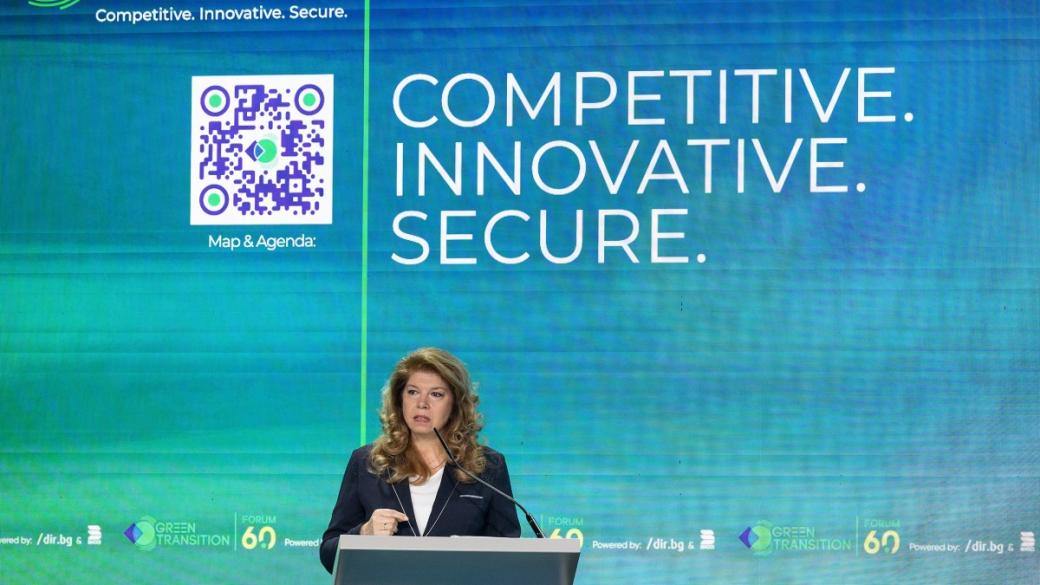
 The new European priorities – defense, innovation, artificial intelligence, and energy security – must not be pursued at the expense of cohesion policy. This was stated by President Iliana Yotova at the opening of the sixth edition of the Green Transition international forum. According to the Head of State, European competitiveness will not be restored by drawing new dividing lines, but through genuine cohesion, a common market without hidden barriers, and the participation of all Member States in the new economy.
In her remarks, Yotova emphasized that we live in a rapidly changing world that is outpacing changes in European policies. She stressed that security has returned to the center of the European agenda, and global supply chains are being reorganized.
In this environment, competitiveness is a matter of sovereignty, income, jobs, social stability, and political dignity,” the president told representatives of the European Commission, the business community, and academia.
A Competitiveness Fund, but Not Just for the Rich
The head of state placed significant emphasis on the upcoming debate on the EU’s Multiannual Financial Framework (2028 – 2034). In her words, this discussion will determine whether the EU will remain a union of solidarity or will turn into a “multi-speed Europe,” where stronger countries gain rapid access to capital and technology, while the rest are forced to constantly play catch-up.
It seems like a convenient mechanism for faster decisions, but in the long term, it carries the risk of political fragmentation, regional blocs, and new invisible borders within the Union,” Yotova warned.
She noted that Europe does indeed need a new European Competitiveness Fund, but it should not finance a “new concentration” from which only the countries with the strongest administrative and corporate capacity would benefit. To avoid this, the head of state insisted on clear regional guarantees and the creation of consortia in which at least one smaller or catching-up economy must participate.
The South-North Corridor
The vision of the physical dimension of cohesion and the role of the Balkans sparked particular interest in the speech.
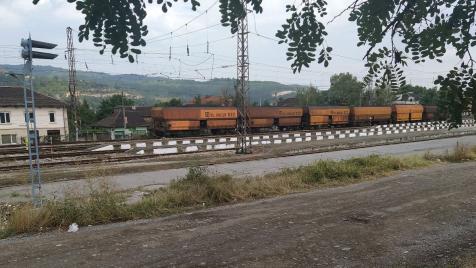
Competitiveness has a physical infrastructure. It is not just a regulation, a budget, or a slogan, but also a power line, a railway line, a port, a data center, a laboratory. Europe must return to these concrete realities,” the president emphasized.
In this context, Yotova outlined Bulgaria’s enormous potential to become a logistics and transport hub through the emerging South-North vertical axis, which runs from Greek ports through Bulgaria and Romania to Moldova and Ukraine.
According to the head of state, this axis is of key importance for trade and Ukraine’s recovery and must be recognized as a strategic European corridor. Yotova was adamant that the project must be funded as a pan-European initiative, not as a mere collection of national segments.
If the European Union wants real diversification of supply chains, the Balkans cannot be an infrastructural periphery. They must be part of the heart of the new European logistics,” she emphasized.
As another successful example of strategic autonomy in action, Yotova cited the Vertical Gas Corridor, which connects Greek terminals, Bulgarian infrastructure, and Romanian links.
Bulgaria can be the voice of cohesion policy in the new era of competitiveness, Yotova further noted. The country’s decision to host one of Europe’s artificial intelligence gigafactories proves that regional development and high technology are not mutually exclusive.
At the end of her speech, the president referred to the landmark reports by Mario Draghi and Enrico Letta, insisting that their diagnoses for Europe be transformed into a concrete roadmap for action.
If there are no deadlines, there is no implementation. If there is no implementation, there is no trust. And if there is no trust, the European project will be attacked not only from the outside, but also from within,” stated Iliana Yotova, proposing that the EU adopt a European Pact for Implementation with measurable goals by 2030.
Translated with DeepL.
Co-Funded by the European Union. Views and opinions expressed are however those of the author(s) only and do not necessarily reflect those of the European Union. The European Union cannot be held responsible for them.